Searchable directory
Find professors by name, school, department, and course context.

A lightweight, moderated hub for discovering professors, comparing teaching experiences, and sharing useful course feedback.
Find professors by name, school, department, and course context.
See overall quality, clarity, helpfulness, difficulty, and would-take-again signals.
Reviews remain pending until an administrator approves them for publication.
Specific, respectful feedback helps future students make better decisions.
Back to topBadawy Arabic News is a responsive, multilingual WordPress newspaper theme designed primarily for Arabic news websites, online magazines, independent publications, and editorial platforms.
The theme provides a complete right-to-left Arabic reading experience while retaining English as its fallback language. It can also be used with multilingual plugins to publish Arabic and English content on the same website.
Badawy Arabic News was designed around the requirements of Arabic journalism rather than treating right-to-left presentation as an afterthought.
When the WordPress site language is set to Arabic, the included Arabic translation and RTL stylesheet activate automatically. Navigation, headlines, article cards, sidebars, forms, captions, and other interface elements are displayed in the appropriate right-to-left direction.
The homepage is organized like a modern digital newspaper. It includes:
The theme uses existing WordPress posts and categories. There is no proprietary content format, making it easier to change themes or export content later.
Arabic localization is included with the theme. English source strings remain available as the default fallback, and a translation template is included for creating additional language files.
For websites that publish in Arabic and English simultaneously, Badawy Arabic News can be used with a multilingual content-management plugin such as Polylang or WPML. These plugins can manage translated posts, categories, pages, and language-specific navigation menus.
Multilingual plugins are separate products and are not bundled with the theme.
Badawy Arabic News supports the WordPress block editor and includes editor styling to provide a closer match between the editing screen and the published article.
The theme also provides:
After activating the theme, open:
Appearance → Customize → Newspaper Options
You can configure:
The theme includes the following widget locations:
These areas can display standard WordPress widgets and compatible widgets supplied by separately installed plugins.
The theme uses standard WordPress posts, categories, widgets, menus, shortcodes, comments, and block APIs. It is designed to remain compatible with properly developed WordPress plugins.
Articles generated by Badawy AI Draft Generator are saved as standard WordPress posts. After editorial review and publication, they automatically use the newspaper theme’s article and homepage layouts.
The Badawy App Launcher shortcode can be placed inside articles, pages, or shortcode-compatible widget areas to direct mobile visitors to an associated iPhone or Android application.
Plugins are installed and activated separately. Badawy Arabic News does not automatically install, activate, or require any commercial plugin.
Badawy Arabic News does not include analytics, advertising networks, tracking scripts, external fonts, or remote JavaScript resources.
The theme does not transmit website or visitor information to the theme developer. Any data processing introduced by separately installed plugins, advertisements, embedded media, or analytics services is governed by those components and their respective privacy policies.
The theme includes keyboard-accessible navigation, visible focus states, a skip-to-content link, semantic navigation landmarks, screen-reader text, responsive typography, and accessible menu controls.
Website administrators remain responsible for ensuring that their published content, images, videos, links, color choices, and installed plugins meet their applicable accessibility requirements.
Badawy Arabic News is free software distributed under the GNU General Public License, version 2 or later.
Copyright © 2026 Wael Badawy.
Badawy Arabic News is designed and developed by Wael Badawy.
Visit the official Wael Badawy website
The theme provides presentation and editorial-layout tools. It does not guarantee compliance with any legal, accessibility, privacy, journalistic, or regulatory standard. Website owners should review their configuration, content, installed plugins, and applicable obligations before launching a public publication.
Badawy Arabic News is a responsive, multilingual WordPress newspaper theme designed primarily for Arabic news websites, online magazines, independent publications, and editorial platforms.
The theme provides a complete right-to-left Arabic reading experience while retaining English as its fallback language. It can also be used with multilingual plugins to publish Arabic and English content on the same website.
Badawy Arabic News was designed around the requirements of Arabic journalism rather than treating right-to-left presentation as an afterthought.
When the WordPress site language is set to Arabic, the included Arabic translation and RTL stylesheet activate automatically. Navigation, headlines, article cards, sidebars, forms, captions, and other interface elements are displayed in the appropriate right-to-left direction.
The homepage is organized like a modern digital newspaper. It includes:
The theme uses existing WordPress posts and categories. There is no proprietary content format, making it easier to change themes or export content later.
Arabic localization is included with the theme. English source strings remain available as the default fallback, and a translation template is included for creating additional language files.
For websites that publish in Arabic and English simultaneously, Badawy Arabic News can be used with a multilingual content-management plugin such as Polylang or WPML. These plugins can manage translated posts, categories, pages, and language-specific navigation menus.
Multilingual plugins are separate products and are not bundled with the theme.
Badawy Arabic News supports the WordPress block editor and includes editor styling to provide a closer match between the editing screen and the published article.
The theme also provides:
After activating the theme, open:
Appearance → Customize → Newspaper Options
You can configure:
The theme includes the following widget locations:
These areas can display standard WordPress widgets and compatible widgets supplied by separately installed plugins.
The theme uses standard WordPress posts, categories, widgets, menus, shortcodes, comments, and block APIs. It is designed to remain compatible with properly developed WordPress plugins.
Articles generated by Badawy AI Draft Generator are saved as standard WordPress posts. After editorial review and publication, they automatically use the newspaper theme’s article and homepage layouts.
The Badawy App Launcher shortcode can be placed inside articles, pages, or shortcode-compatible widget areas to direct mobile visitors to an associated iPhone or Android application.
Plugins are installed and activated separately. Badawy Arabic News does not automatically install, activate, or require any commercial plugin.
Badawy Arabic News does not include analytics, advertising networks, tracking scripts, external fonts, or remote JavaScript resources.
The theme does not transmit website or visitor information to the theme developer. Any data processing introduced by separately installed plugins, advertisements, embedded media, or analytics services is governed by those components and their respective privacy policies.
The theme includes keyboard-accessible navigation, visible focus states, a skip-to-content link, semantic navigation landmarks, screen-reader text, responsive typography, and accessible menu controls.
Website administrators remain responsible for ensuring that their published content, images, videos, links, color choices, and installed plugins meet their applicable accessibility requirements.
Badawy Arabic News is free software distributed under the GNU General Public License, version 2 or later.
Copyright © 2026 Wael Badawy.
Badawy Arabic News is designed and developed by Wael Badawy.
Visit the official Wael Badawy website
The theme provides presentation and editorial-layout tools. It does not guarantee compliance with any legal, accessibility, privacy, journalistic, or regulatory standard. Website owners should review their configuration, content, installed plugins, and applicable obligations before launching a public publication.
Badawy AI Draft Generator is a WordPress plugin that helps authorized users generate review-ready post drafts using an AI provider configured through the WordPress AI Client.
The plugin provides a straightforward WordPress administration screen for entering a topic, language, writing tone, target word count, SEO keywords, category, and additional editorial instructions. Generated content is saved within the normal WordPress post workflow for review and editing.
Badawy AI Draft Generator requires WordPress 7.0 or later. It uses the provider-agnostic AI Client included with WordPress instead of making direct requests to individual AI providers.
A site administrator must install a compatible AI provider plugin and configure the corresponding account under Settings → Connectors. WordPress then selects a compatible text-generation model from the providers available on the website.
The plugin does not store provider API keys, hard-code AI model identifiers, or operate its own remote AI service.
Generating an article requires communication with an external AI provider. When an authorized user selects Generate Post, the topic, requested language, tone, target word count, SEO keywords, additional instructions, and generation prompt are sent through the WordPress AI Client to a provider configured by the website administrator.
Depending on the provider plugin installed on the website, the external service may include:
Other compatible provider plugins may add support for additional services. Administrators should review the active provider’s pricing, terms, privacy policy, data-retention practices, and acceptable-use requirements before enabling it.
Badawy AI Draft Generator does not add front-end analytics, advertising, tracking technologies, or cookies. It does not receive or store AI-provider credentials.
Generated posts are stored in the website’s WordPress database. The plugin may also save the generated SEO title and meta description as post metadata. Information sent to an external AI provider is governed by that provider’s terms and privacy practices.
AI-generated content can contain incorrect, incomplete, outdated, or misleading information. The plugin does not browse the web or independently verify facts. Users should review, fact-check, and edit every generated article before publication.
Badawy AI Draft Generator is independently developed by Wael Badawy. It is not endorsed by, affiliated with, or sponsored by Anthropic, Google, OpenAI, or other AI providers. Product and company names are trademarks of their respective owners.
Badawy AI Draft Generator is free software distributed under the GNU General Public License, version 2 or later.
A draft-first WordPress plugin for generating articles with Google Gemini, OpenRouter, or OpenAI using API keys supplied by the site administrator.
AI Draftsmith helps WordPress editors create structured post drafts from a topic and a small set of editorial instructions. The plugin is designed around human review: generated posts are saved as drafts by default so an editor can verify, revise, and approve the content before publication.
Choose Google Gemini, OpenRouter, or OpenAI from the WordPress administration area.
Create posts in Arabic or English with selectable tone and target word count.
Draft is the default post status. Publishing remains under the control of authorized WordPress users.
Generate an excerpt, suggested SEO title, meta description, tags, and WordPress-ready HTML.
An optional workflow can try configured free or free-tier providers before a paid provider.
No AI account is bundled. Administrators use their own provider credentials and billing arrangements.
API keys can be entered in the plugin settings. Administrators who prefer not to store credentials
in the WordPress options table can define them in wp-config.php.
define('GEMINI_API_KEY', 'YOUR_GEMINI_API_KEY');
define('OPENROUTER_API_KEY', 'YOUR_OPENROUTER_API_KEY');
define('OPENAI_API_KEY', 'YOUR_OPENAI_API_KEY');
Only configure providers you intend to use. Never publish API keys in posts, pages, themes, or public repositories.
AI Draftsmith connects to external AI services only when an authorized WordPress user explicitly requests content generation. The plugin itself does not operate an independent SaaS backend.
| Provider | Purpose | Data that may be sent |
|---|---|---|
| Google Gemini API | Article generation | Topic, language, tone, target length, keywords, optional instructions, and generated prompt. |
| OpenRouter | Article generation and free-model routing | Topic and generation instructions; site-identification headers may also be sent where required by the provider. |
| OpenAI API | Article generation or optional paid fallback | Topic, language, tone, target length, keywords, optional instructions, and generated prompt. |
API keys are sent only to their corresponding providers for authentication. Data sent to a provider is governed by that provider’s own terms, privacy policies, retention practices, quotas, and pricing.
AI-generated text can contain errors, outdated information, or unsupported claims. AI Draftsmith is designed as a writing assistant rather than an autonomous publisher. Site owners and editors remain responsible for reviewing accuracy, copyright, attribution, legality, safety, and suitability before publication.
| Current Version | 1.0.0 |
|---|---|
| WordPress | Requires WordPress 6.0 or later |
| PHP | Requires PHP 7.4 or later |
| License | GNU General Public License v2 or later |
| Author | Wael Badawy |
| Plugin Page | https://www.waelbadawy.com/ai-draftsmith/ |
For information about the author and future plugin updates, visit WaelBadawy.com. Once the plugin is accepted in the WordPress.org Plugin Directory, the official directory page can also be linked here.
Wish you the best for you and your family – Happy Eid
Prof. Wael Badawy @wbadawy @waelbadawy

The draft data protection law is concerned with the privacy and security of the personal data of Egyptian citizens and foreigner individuals who live in Egypt. It is Egypt’s version of the GDPR.
The draft law protects any personal data, if it leads to identifying an individual. Examples include his/her name, address or photo. The law provides an additional layer of protection to sensitive data, such as an individual’s religion and his/her medical information. It sets the rights of individuals in relation to their personal information, such as their right to ask that their data be deleted, and the obligations of organizations collecting or processing data.
The main features of the draft law that may affect you as a business are:
Who should worry and why?
Any person collecting, controlling, processing and/or holding personal data for uses that are non-personal. This would basically include every business, company or other organization operating in Egypt. The consequences for non-compliance are severe; ranging from imprisonment and fines and up to revoking data related licenses and publication of the criminal verdict in media outlets.
How much time do you have to set your house in order?
Those included within the scope of the law will be expected to comply within 18 months from the issuance of the law (that is if the executive regulations are issued on schedule).
What should you do?
The starting point is to track the data cycle from when your organization receives the data, processes, and stores it until the data is deleted. Next, make sure you comply with each of the data protection principles as they have been emptied into legal obligations (see more on that below). Document this in a policy and implement it. Don’t forget to train your people.
Now you have an idea of the main highlights of the law and you want to understand more how data is handled under the law? Deep dive into the below explanation of the data protection principles adopted by the law.
Seven key principles for data protection
These are set in stone under the GDPR and mirrored in the Law:
We fleshed out three of the principles for you to get a clear idea:
The principle – You must not collect or keep any personal data in electronic or physical form, except for lawful purposes, such as one of the following purposes:
You must reveal the purpose of the data collection and processing.
How to comply? Ask yourself why you are collecting this data and if you are also processing it. Make sure your reasons are legitimate; where possible obtain the person’s consent. Inform the data subject.
Obtaining consent is the gold standard. Usually, document anonymization is used in medical applications and research.
Example – think of a financial institution keeping personal data to comply with its Know Your Customer (KYC) requirements under anti-money laundry laws.
The principle – You must (i) ensure that the data collected is correct, and (ii) correct any inaccurate personal data.
How to comply? – Map your data; review it, make sure it is correct; and put in place workflows that allow data subjects to review their data and correct it.
Example – when a person’s address is part of the data collected, and the individual does not reside at that location anymore, you need to (i) correct the data; or (ii) include such address as the last known address/previous place of residence.
The principle – You need to take the necessary technical and organizational measures for the protection of personal data to ensure there is no breach of confidentiality, hacking, destruction, alterations or damage to the personal data. You also need to appoint a data protection officer, who shall be registered with the regulator. This officer must carry out regular evaluation and checks of the data protection systems and document that.
How to comply? – Appoint a data protection officer; review your systems and workflows; draft a data security policy and implement it; train your people; and report data leakages when they happen.
Example – A business should not only address cybersecurity risks; it should also put in place technical measures (e.g. a secure process for disposal of documents containing Personal Data; securing access to locations/premises containing documents/devices with access to personal data). In addition, a business should take organizational measures (e.g. ensuring coordination between the relevant members of the organization on security processes like disposal of IT equipment which were used to store personal data).
What needs to change in the current draft?
Data protection is good and eventually leads to a better business environment for all of us. But, we are mostly worried about the imprisonment sanctions which, as currently drafted, are extraterritorial. This represents a personal threat to senior executives in Silicon Valley and Seattle. We see this as a disabling threat that may cause some companies to reconsider their investments in Egypt. The draft law is essentially borrowed from the GDPR. But on the sanctions part, we seem to have lost our sense of where the world is going and decided to go in the opposite direction.
Our Technology & Innovation team welcomes your questions: wael@waelbadawy.com

What is the power of one cent?
To answer this question, imagine that one cent doubles every day. As shown in the table, one cent after 9 days can buy you a coffee at $2.56. One cent, after 20 days, can buy a car at $5,242.88. One cent after 30 days can buy your dream that is worth $5 Million dollars. AND, you keep it to the following day, you will become a double-digit millionaires. One cent will be a $1,374,389,534.72 on day 38 and will be $5,497,558,138.88 on day 40.
Then what? The model above presents the strength of a network. I can recruit my team to double every day, or a week or a month. I can reach a powerful result if I have the passion and dedication. The model is also applicable to sales, if I can double my sales every day, I can reach amazing business size after 30 cycles. The cycle can be one week, one month, or even one year. Just keep it doubling and do not rush and have the passion to be a billionaire starting with one cent.
Wael Badawy, “Hierarchical Adaptive Structure Mesh for Efficient Video Coding,” The International Journal on Image and Video Processing, Vol. 17, November 2001
A Trip Around the World with DWIGHT L. ELMENDORF, Lecturer and Traveler.
Close beside the cathedral of St. Mark stands the square Campanile, the most prominent feature in all Venetian views. Standing 325 feet high, the Campanile always dominated the picturesque low stretch of Venice’s skyline and gave a peculiar distinction to the whole scene. It seemed indeed to many Venetians and to lovers of Venice all over the world that the city had lost its crowning feature when, in 1902, the Campanile collapsed. It was originally erected in 900 and rebuilt in 1329. After it had fallen Venice seemed maimed, and the hearts of thousands felt the depression until the tower was rebuilt and the city could once again hold up its beautiful head. A new tower was built by Piacentini (pee´-ah-chen-tee´-nee) during the years 1905 to 1911, and on completion it was consecrated with most impressive ceremonies.
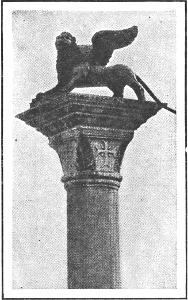
LION OF ST. MARK’S
The Doge’s Palace was originally founded about 800; but was destroyed by fire five times, and each time rebuilt on a grander scale. The older part of the present edifice was built in 1309; while the west wing, facing on the piazzetta, was built between 1424 and 1438 by the celebrated architects Buon, father and son.
In gazing at the Doge’s Palace the eye is first caught by the upper arcade. From there the sentences of the “Council of Ten” were pronounced—listened to by the assembled people in silence and in awe.
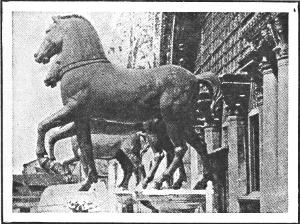
THE BRONZE HORSES OF ST. MARK’S
These horses are among the finest of ancient bronzes. They probably once adorned the triumphal arch of Nero, emperor of Rome.
The columns of this arcade are most beautiful, and have been pointed to with pride for years. Ruskin describes the detail of the sculptured columns, and declares that they are the finest of their kind in Europe. The interior of the Doge’s Palace is wonderful. Tintoretto’s painting of “Paradise” is there, a marvel in size and in detail. The residence of the Doges and the apartment in which the authorities held their meetings are there, revealing still much of their ancient glory. The palace is virtually a museum, and it shows a great display of fine paintings, containing, among others, notably works of Tintoretto, Paul Veronese, (vay-ro-nay´-seh) and Palma Giovane (jo-vah´-neh). Days could be spent profitably wandering through these halls, studying the treasures of art and history to be found there.
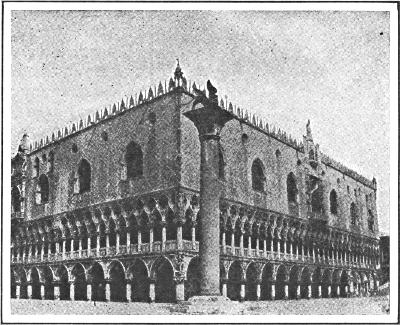
THE PALACE OF THE DOGES
The Doge’s Palace is said to have been founded beside the church of St. Theodore about 800 for the first Doge of Venice. It has been rebuilt and altered many times.
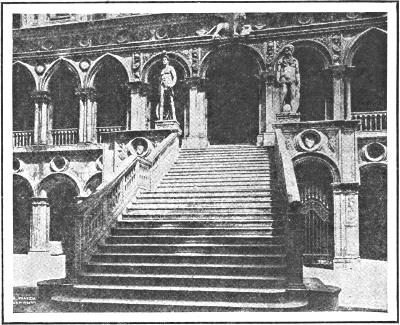
SCALA DEI GIGANTI, DOGE’S PALACE
The Stairway of the Giants, so called from the colossal statues of Mars and Neptune at the top, leads to the Palace of the Doges. On the highest landing of these steps, in the later days of the Republic, the Doges were crowned.