
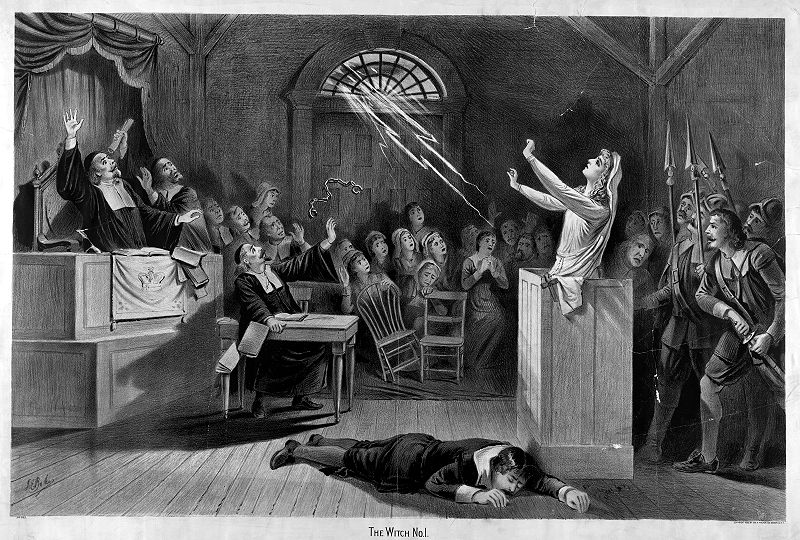
Trials in Superstitious Ages.
By Ernest H. Rann.
IN superstitious ages, when belief in the power of the law to adjust all quarrels, to hold the balance equally between man and man, and to accord to each one his rights, was less prevalent than it is at the present day, disputants naturally resorted to other tribunals for the settlement of their claims. A perfect system of law was impossible; what law existed was arbitrarily administered, often for the benefit of the most powerful litigant, and the claimant with only justice on his side often had the mortification of seeing a verdict given against him. During the development of a system of law-giving, when the accumulated experience of humanity had not sufficed to produce perfection, man in his darkness, his ignorance, and superstition, turned to the supernatural, and devised certain ceremonies by which the judgment of God might be evoked to demonstrate the guilt or innocence of the accused.
The antiquity of the ordeal, as it was called, cannot be measured. Such a form of trial is found to have existed in the earliest ages, and even now traces of it linger among savage tribes of the earth. In Africa especially the ordeal is well known. During his travels among the negro tribes north of the Zambesi, Dr. Livingstone encountered the curious practice of the “mauvi,” which consisted of making all the women of a tribe drink an infusion of “goho,” for the purpose of ascertaining which of them had bewitched a particular man. The accused women were drawn up in a row before the hut of the king, and the draught administered to them. Those who were unable to retain the horrible decoction, and vomited, were considered innocent of the charge: those who were purged were adjudged guilty, and put to death by burning.
The Calabar bean is also used by the natives of Africa in the form of an emulsion as an ordeal for persons accused of witchcraft, proof of innocence consisting of ability to throw off the poison by vomiting. Among the Barotse tribes the process is conducted by deputy, the testing liquid being poured down the throat of a dog or cat, and the accused person being treated according to the effect produced on the animal. Among the Dyak tribes lumps of salt are thrown into a bowl of water by the accuser and accused, and judgment is given against the owner whose lump disappears first. Another method adopted by the Dyaks is for each of the two parties to choose a mollusc, and to squeeze over it a few drops of lime-juice; the owner of the mollusc which moves first under the acid stimulant losing the case. Ratzel mentions that among the Malay tribes ordeals by fire, ducking, pulling a ring out of boiling water, or licking red-hot iron, are still frequent. Where the ordeal fails to produce the desired result, wager of battel, in reality another form of ordeal, is resorted to. Among the Tagals it is usual to light a consecrated candle, and to consider the person guilty of the crime under consideration to whom the candle flame is blown during the performance of the ceremony. The Igorrotes have a more painful method of fixing guilt. The accuser and the accused are placed together; the backs of their heads are scratched with a sharply-pointed bamboo stick, and the man who loses most blood also loses his case.
In Hawaii ordeals are administered by the priests, the suspected person being compelled to hold his hands over consecrated water, and adjudged guilty if the liquid trembles in the vessel while the priest looks at him. The Siamese have a form of ordeal which consists of making the two parties to a suit swallow consecrated purgative pills, the man who retains them for the greater length of time winning the case.
Even among the comparatively enlightened races of the peninsula of India, ordeals of the most elaborate and curious character are practised at the present time. Warren Hastings mentions that in his day no fewer than nine forms were in use among the Hindoos. The ordeal of the balance was commonly employed, and is still in force in certain districts. The beam is adjusted, and both scales made perfectly even. After the accused has been bathed in sacred water, and the deities worshipped, he is placed in the scale-pan and carefully weighed. When he is taken out the Pandits pronounce an incantation, and place round his head a piece of paper setting forth the charge against him. Six minutes later he again enters the scale, and the balance is called upon to show his fault or innocence. If he weigh more than before, he is held guilty; if less, innocent; if exactly the same, he must be weighed a third time, when, according to the Mitácsherá, a difference in his weight will be observable. Should the balance break down, the mishap would be considered as proof of the man’s guilt.
The ordeal of the balance is not altogether unknown in English history, for an incident is recorded in which Susannah Haynokes, of Aylesbury, was accused of bewitching her neighbour’s spinning-wheel, and preventing it from working properly. Susannah loudly protested her innocence, and demanded an ordeal to prove it. She was taken to the church, and weighed in a semi-nude condition against a copy of the Bible, and being able to outweigh the Scriptures, was considered to be innocent of the offence charged against her. Possibly it never occurred to the owner of the spinning-wheel that lack of oil was the cause of its refusal to go round.
Among other ordeals in use by the Hindoos is that of iron, the accused being required to lick a red-hot bar of the metal. If his tongue be burnt, he is considered guilty, if not, he is reckoned innocent, but it cannot be supposed that among tribes addicted to this practice the injury to the tongue is considered sufficient punishment for the offence with which the suspect is charged. The poison ordeal, employed also, it may be noted, by the Hovas of Madagascar, is commonly practised. A small quantity of vishanága, a poisonous root, is mixed with clarified butter, which the accused must eat from the hand of a Brahman. If the poison produce no visible effect, he is absolved; otherwise, condemned. In other cases the hooded snake called nága is placed in a deep earthen pot, from which the accused has to take a ring, seal, or coin without being bitten, when he is considered innocent. In trial by the Cósha the accused is made to drink three draughts of water in which images of the Sun, of Dévì, and other deities have been washed. If, within fourteen days, he is afflicted with any form of sickness, he is considered guilty.
For the fire ordeal an excavation is made in the ground, and filled with burning pippal wood. Into this a person must walk bare-footed without hurt in order to prove his innocence. Hot oil ordeals are also in force, when the accused has to thrust his hand into the liquid without being burned; and chewing a grain of consecrated rice, which, if it comes from the man’s mouth dry or stained with blood, is considered proof of his guilt. At other times a silver image of the Genius of Justice, called Dharma, is thrown with an image of iron or clay, called Adharma, into an earthen jar; and the accused is acquitted if he bring out the silver image, but condemned if he draw forth the iron.
The history of the middle ages furnishes numerous examples of ordeals employed in the settlement of disputes, which in the absence of a strong and impartial system of law-giving, found great favour with the people of all ranks. They were peculiarly distinguished by the appellation of Judicium Dei, or judgments of God, and sometimes called vulgaris purgatio. The law of the Church sanctioned the ordeal throughout Europe for a considerable period, and faculties were freely given by the clergy for the performance of these strange ceremonials. Indeed, the whole business, as a judgment of God, was frequently conducted by the servants of the Church, always in consecrated ground, and the sacred edifice itself was occasionally requisitioned in order to add greater solemnity to the proceedings. The ordeal of fire, practised, curiously enough, by the Greeks in the time of Sophocles, was allowed only to persons of high rank. The accused was required to carry a piece of red-hot iron for some distance in his hand, or to walk nine feet, bare-footed and blind-fold, over red-hot ploughshares. The hands or feet were then immediately bound up, and inspected three days afterwards. If, on examination, no injury was visible, the accused was considered innocent; if traces of the burning remained, he was reckoned guilty, and received punishment commensurate with his offence, without any discount for the harm he had already suffered.
The most notable historic instance of this form of ordeal is that of Queen Emma, mother of Edward the Confessor. She was accused of a criminal intrigue with Alwyn, Bishop of Winchester, and condemned to the ordeal of fire, which, on this particular occasion, took the form of nine red-hot ploughshares, laid lengthwise at irregular intervals, over which she was required to walk with bandaged eyes. She passed successfully through the severe trial, and at the conclusion innocently asked when the ordeal was about to begin. The Queen’s innocence was, to the popular mind, established more substantially than would have been possible in any existing court of law. She was not the only gainer by the restoration of her reputation, for in consideration of the success which had attended her, she settled twenty-one manors on the Bishopric and Church of Winchester.
In the Eastern Empire the fire ordeal was largely used by the Emperor Theodore Lascoris for the discovery of the origin of the sickness with which he was afflicted. His majesty attributed the malady to magic, and all suspected persons were required to handle red-hot iron in order to establish their guilt or innocence, “thus joining,” as an ancient scribe exclaims, “to the most dubious crime in the world the most dubious proof of innocence.”
Fire, as we have said, was employed for persons of high rank: those of baser degree, especially bondsmen and rustics, were tried by the ordeal of boiling water. “I will go through fire and water for my friend” was a common expression in the middle ages, and, though having lost its original significance, the saying has persisted to the present time as a declaration of self-sacrifice. The accused person was required to take a stone from a pan of boiling water, to insert the hand and wrist into the liquid, and in case of the triple ordeal, to plunge the arm in up to the elbow. When cold water was employed, and in cases of witchcraft this was generally resorted to, the suspect was flung into a river or pond. If he floated without appearance of swimming, he was pronounced innocent; if he sank, he was condemned as guilty—rather a superfluous proceeding, considering that the man was in all probability already drowned.
It would be going too far to assert that in all cases these ordeals were carried out with the strictest impartiality and consideration for the ends of justice. Means were not unknown to circumvent the peculiar forms of the trial, and precautions were often taken by the clergy, as might have been done in the case of Queen Emma, to protect those whom they desired to clear of suspicion. It is a well-known fact that white-hot iron may be licked with impunity, and the Mevleheh dervishes are proficient in the trick of holding red-hot iron between their teeth. Sometimes cold iron, painted red, was employed, and at others the fire reduced in temperature at the critical moment, the suspect receiving only such injury as would heal in the three days allowed before his hand was examined. Artificial preparations were frequently employed, while the suspect had at times the option of going alone into the church, and in all cases of keeping the crowd of spectators at a distance, which made minute inspection of the proceedings impossible.
Another form of ordeal was the judicium crucis, or trial of the Cross, employed largely in criminal cases. When an accused person had declared his innocence on oath, and appealed to the judgment of the Cross, two sticks were prepared precisely like one another. The figure of the Cross was cut upon one of these sticks, and the other left blank. Each of them was wrapped in fine white wool, and laid upon the altar or the relics of the saints, after which a prayer was uttered that God might discover by unmistakable signs whether the prisoner was innocent or guilty. The priest then approached the altar, took up one of the sticks, and uncovered it. If it happened to be the stick marked with the cross, the prisoner was pronounced innocent; if it were the other, he was condemned as guilty. A different form of this ordeal was adopted when the judgment of the Cross was invoked in civil cases. The judges and all parties to the suit assembled in the church. Representatives, generally the youngest and strongest priests, were then chosen, and required to stand one on each side of a crucifix. At a given signal they stretched out their arms at full length, so as to form a cross with their body, and in this painful posture they continued to stand during divine service. The party whose representative dropped his arms first, or shifted his position, lost his cause. History records a dispute over a monastery, between the Bishop of Paris and the Abbot of St. Denis, which was settled in this manner. A crowd assembled, and arranged bets on the result, but those who supported the Bishop’s man were sadly disappointed, for he dropped his arms at an early stage, and lost the cause of his employer. The ordeal of the Cross was abolished by Louis de Debonnaire in 816, on the ground that it was irreverent in character.
Ecclesiasticism also played a prominent part in the ordeal of the corsnedd, to which persons accused of robbery had to submit. The corsnedd was a piece of bread made of unleavened barley, to which cheese made of ewe’s milk in the month of May was added. Over the whole, one ounce in weight, a form of exorcism was uttered, desiring of the Almighty that the corsnedd might cause convulsions and paleness, and find no passage, if the man were really guilty, but might turn to health and nourishment if he were innocent. The practice is strongly remindful of the trial of jealousy in use among the Israelites, by which an unfaithful woman was compelled to drink holy water containing dust of the floor of the tabernacle, the belief being that she would be stricken with illness if she were guilty. The corsnedd was given to the suspected person, who at the same time read the sacrament. Godwin, Earl of Kent, was, in the reign of Edward the Confessor, accused of murder, and forced to the ordeal of the corsnedd, when, according to ancient chroniclers, the consecrated food stuck in his throat, and caused his death. Both the expressions, “I will take the sacrament upon it,” and “May this morsel be my last,” are supposed to have been derived from this curious form of law-giving. A somewhat similar custom is in vogue in Russia at the present day. Balls of bread are made and dropped into consecrated water, the priest meanwhile reciting the formula:—“Ivan Ivanoff, if you are guilty, as this ball falls to the bottom, so your soul will fall into hell.” As a rule the culprit confesses immediately. In Ceylon, also, a similar form of ordeal is by no means unusual. A man suspected of theft is required to bring the person he holds in greatest affection before the judge, and placing a heavy stone on the head of his substitute, say, “May this stone crush thee to death if I am guilty of the offence.” The Tartar sets a wild bear and a hatchet before the tribunal, saying as he does so, “May the bear devour me, and the hatchet chop off my head, if I am guilty of the crime laid to my charge.”
Another form of ordeal which was cherished and practised with assiduity was that of the bier, founded on the belief that the body of a murdered man would show signs, by bleeding or movement, when his assassin approached. The accused had to place his hand on the naked breast of the corpse, and declare his innocence, though the slightest change in the body was considered proof of his guiltiness. This method of finding out murderers had its origin, it is believed, in Denmark, where it was in the first instance adopted by King Christian II. for the discovery of the murderer of one of his courtly followers. The belief has survived to a certain extent to the present day, for even English peasants still expect all persons present at a funeral to touch the body in proof of their bearing no ill-will towards the dead man.
Not so frequently employed, but still occasionally met with in ancient history, was the ordeal of compurgation, where the innocence of the accused was sworn to by his friends, and judgment went against the party whose kindred refused to come forward, or who failed to provide the necessary number of compurgators. It was a conflict of numerical strength, and the higher number carried the day.
Another custom, still surviving, was to tie a key in a Bible opened at Psalm L, verse 18, “When thou sawest a thief, then thou consentedst with him,” and balance the whole, the belief being that the book would turn in the hands of a guilty person.
Challenging the accuser to mortal combat was a proceeding which found much favour with the warlike spirit of the middle ages. Of course it was considered that Providence would defend the right, even if a miracle were needful, but nevertheless each party placed considerable reliance on his own strength of arm and fighting skill. These judicial combats were in ancient times practised among the Jews, and were also common in Germany in remote ages, though they do not find mention in Anglo-Saxon laws, and were apparently not in use in England until after the Norman Conquest. In Germany a bier was placed in the midst of the lists, accuser and accused stood respectively at the head and foot, and remained for some minutes in profound silence before they commenced fighting. Civil, criminal, and military cases were, in the absence of sufficient direct evidence, decided by means of the judicial combat or wager of battel. The offended party had the right to challenge his accuser to settle the dispute by force of arms, and the forms and ceremonies connected with the trial are well illustrated in the opening scenes of “King Richard II.” The combat took place in the presence of the court itself, Heaven being expected to give the victory to the innocent or injured party. It was commonly resorted to in charges of treason, as in the above-mentioned dispute between Henry Bolingbroke and Thomas Mowbray, when the ceremonies were of an imposing character. As in the majority of ordeals, deputies could be chosen to perform the requisite duties, but the principals were in all cases answerable for the consequences. No commoner was allowed to challenge a peer of the realm, nor could the citizens of London, for some obscure reason,
indulge in these popular forms of legal administration. Each of the combatants professed his willingness to make good his claims, body for body—
“For what I speak
My body shall make good upon this earth,
Or my divine soul answer it in heaven.”
Neither sorcery nor witchcraft had to be employed, and the battel was to continue until the shades of evening had fallen, and the stars appeared. If the accused were killed, his blood was attainted, but if he were only vanquished, he was immediately condemned to an ignominious death by hanging, providing he accepted his fate without demur. The defeated party, however, might crave his life, in which case he was allowed to live as a recreant, on condition that he retracted unreservedly the false statements that he had sworn.
At the Durham Assizes, on August 6, 1638, a wager of battel was offered and accepted, for deciding the rights to land at Thickley, between Ralph Claxton, demandant, and Richard Lilburne, tenant. According to an old chronicle, “the defendant appeared at 10 o’clock in the forenoon, by his attorney, and brought in his champion, George Cheney, in full array, with his stave and sandbag, who threw down his gauntlet on the floor of the court, with five small pieces of coin in it. The tenant then introduced his champion, William Peverell, armed in the same manner, who also threw down his gage.” But the champions, instead of being allowed to fight, were ordered to appear at the Court of Pleas in the following month. Legal arguments followed, and the trial by battel was eventually postponed indefinitely.
In criminal trials no deputies were allowed, and the parties were compelled to settle their quarrel in person, unless one of them was a woman, an infant, or a man over the age of sixty, or was afflicted with lameness or blindness. In the case of any of these disqualifications, trial by jury could be claimed and insisted upon. One of the most remarkable wagers of battel occurred in 1817. A young woman named Mary Ashford, living at Erdington, near Birmingham, was supposed to have been murdered early one morning when returning from a dance. Suspicion fell on Abraham Thornton, a partner of the previous night, who was tried for the crime and acquitted. Evidence for another trial was collected, and Thornton was appealed by William Ashford, the direct heir male of the murdered woman. But when the proceedings commenced, Thornton’s counsel took refuge under a very old Act, by which no man could be tried on a second charge of murder, on which he had been acquitted, except by wager of battel before the king, between the heir-at-law of the person murdered and the accused. The appellant, Mary Ashford’s brother, declined the combat on the ground of physical inferiority, and Thornton was discharged. Immediately afterwards the antiquated law was removed from the Statute Book.
This marked the end of trials by ordeal as recognised by law. The process of extermination had long been in progress, but popular opinion was against reform, and certain of these curious customs survived. Although the clergy had at first taken part in these ceremonials, and presided over them in church, they came in time to discountenance them. The canon law declared against ordeals as being the work of the Devil, and a decree to this effect was issued in the eighteenth canon of the fourth Lateran Council in November, 1215. Upon this authority it was thought proper, says Blackstone (as had been done in Denmark a century ago), “to disuse and abolish these trials entirely in our courts of justice by an Act of Parliament, Henry III., according to Sir Edward Coke, or rather by an order of the King in Council.” The actual date of the abolition of ordeals by fire and water was 1261. On the Continent these forms of trial had been abolished by civil and ecclesiastical law much earlier, although in 1498 an attempt was made to test the doctrine of Savonarola by means of a challenge from one of his disciples to a Franciscan friar to walk through a pile of burning wood. Old customs die hard, and the incident is a curious and interesting instance of the persistence of a popular form of trial even among the members of a party by which it had been condemned.

The Bible Law.
By S. BURGESS, m.a.
AT the very outset of any treatment of so delicate a subject as that indicated by the title of this chapter, we are met by no small difficulty. This consists in the danger of committing unintentional errors of irreverence, and thus offending the prejudices of those who are more or less pledged to their belief in the verbal inspiration of every Bible chapter and verse. With this risk before us, we can only trust to our own sense of a rational view of a subject so full of capabilities of misconstruction. Those of us who can remember the outburst of righteous indignation at the publication of the “Essays and Reviews” and of “Ecce Homo,” feel surprise at the quiet indifference with which views expressed in them are now received. This does not at all, or necessarily, mean that men’s faith is colder, or that the spirit of reverent religious feelings has died away. The advance of accurate scientific investigation may have upset the faith of some, and given a subject for outbursts of intolerant pulpit denunciations, but we must think that there are signs plainly discernible of a quiet acceptation of modern discovery by the majority of thoughtful and devout believers in the inspiration of Holy Scripture. These remarks will be found not unneedful as we pursue the examination of this particular branch of Biblical study, namely, the Law as it is found in the Bible, and this will be seen at once when it is laid down as an absolutely necessary condition of our investigation that this same Law can plainly be divided into two distinct portions—that which is of Divine, and that which is of human origin. The bare statement of this fact will offend certain prejudices. The Divine “Fiat” stamps with as marvellous and undoubted clearness, certain portions, as other parts are marked by the progress of human intelligence, the needs of human society, and the force of the human will.
The very fact of the existence of Law entails the necessity of Penalty, and this may be spiritual or corporal. The former depends on the acknowledgment of the rule over us of a Superior Being. The latter is a necessary accompaniment of all and every human life, believing or unbelieving. So in the Bible Law we can easily distinguish between the penalty affixed to the breaking of the first of the Ten Commandments, and that which followed on the breaking of the sixth. On the authority of Hebrew scholars, we are told that the use of the Hebrew Article shows that The Law refers to the expressed will of God. If this rule be invariable, it would be of great value, and especially so in the use of the Greek Article.
The writers of the Psalms gave forth an intense reflection of the old Law; always presuming, as they of course did, that it emanated from the Deity.
Now let us be allowed to start with the assumption that the Mosaic is the earliest form of tabulated Law. A most excellent book has just been published, “The History of Babylonia,” by the Society for Promoting Christian Knowledge. It is a cheap little book, but full of information upon which one feels able to rely. We find there that the Moral Law of Babylonia represents the spirit of Bible Law so accurately that it would be absurd to set up any theory of an independent basis.
We must make a date somewhere, and therefore we cannot do better than choose a date that can be fairly tested, and safely on this side of mythical eras,—and that is about 1500 b.c. This must appear a very safe and modest date to fall back upon. The Babylonians want us to go back 432,000 years, but to accept this assertion requires more faith than most of us possess.
For our present purpose there is nothing gained by comparing the Mosaic Law with that discovered with such infinite care and learning in the Babylonian records. The utmost that can be said is that we have startling coincidences, and an intensely interesting subject opened out. But there is no single grain of information, and that is what we are just now in search of. We feel quite distrustful of documents, especially stone ones, which give the lifetime of Alorus as extending to 36,000 years. That was before the Deluge. The Wandering Jew sinks into insignificance, and is a mere puling infant by the side of such figures as these, because the son of Alorus reigned for 46,800 years. However short the “year” was, the period of life was quite lengthy. If a year was our week, the last named patriarch was about 1,000 years old.
This is a departure somewhat from the Law as it is in our Bibles. But it will be an interesting study for some kind student to compare that Law with the echoes thereof found in Asiatic literature, even far away on the eastern shores of China. The mystery still unsolved is, “How did it get there?”
With the greatest diffidence we make the statement that the first notion of Law was in connection with sacrifice. The time may come when this can be refuted. But at present, leaving out of the question natural and unwritten Law, we find no bond but this. Sacrifice comes to us as a Law from a Superior Being. Heathen nations have recognized the efficacy of sacrifice and offerings.
Man without Law was an impossibility. No living thing can exist without some Law. Thus we look back to the first records of created living things for some Law. Science sheds a great, broad, and even scaring, light on the Law prevailing over inanimate nature. The seas and the fields obey it. But for us to make a record of Law as it made its beginning, is a task too great, and it is indeed then we feel that “fools may rush in” where better souls have had to languish in doubt.
Let us take the Law in the Bible as we can read it, and how few care to read it! There was a man once who had read the whole of the first five books through twice. Thinking there might be something to gain from such abnormal study, we propounded a few questions on this very subject. The result was a senseless repetition of verses from Leviticus. And yet, to tell the honest truth, there is very little left us to do but to quote. There is a little assistance we can give, and most thankful we are to have it in our power to do so. Let us all the time remember that the Bible Law is the sole foundation of every Law, Human and Divine, as far as we can discover. If it can be proved that the Babylonian record with its 40,000 year old kings is to be relied on, then by all means let us accept it.
We start with the sacrifice as the “companion” of the Law. No one can feel hurt by this. It is no good to any of us to ask whether Abel’s sacrifice was according to revealed Law or anterior to it. It is plain that sacrifice came to be the great medium of the Law between man and the great prevailing Law. With this allowed, all the rest is easier to grasp. The early Law among the first people seemed to have no force but in its connection with some higher Power. This Power has been now deputed to earthly sources.
The writers of the Psalms represent to us a perfect intercourse with the Deity. The question then arises, “On what grounds was this intercourse conducted?” The answer seems clearly to be on the conditions of the Laws of sacrifice. Now, by comparing the elaborate list of these contained in Smith’s “Dictionary of the Bible” with a very careful one in “Notes on the Hebrew Psalms,” by W. R. Burgess (1879), we can make out a clear and very useful resumé. Leaving out the great sin offerings for the whole people and for the priests, we have the following sin offerings:—
- For any sin of ignorance. Lev. iv. A most elaborate ceremonial of sacrifice and blood sprinkling. We should like to know when the “plea of ignorance” was done away with altogether, as we believe it has no force at all in modern Law.
- For refusal to bear witness on oath. Lev. v. This is of very great interest in the light of recent legislation as to affirmation. We have come across many people, it is needless to add grossly ignorant, who have entirely lost sight of the obvious emphasis on the word “False” in the 9th Commandment, placing the whole force on the fact of “Witness.”
- The Laws as to defilement. These, we presume, have left no trace on modern Law.
- The breach of a rash oath, the keeping of which would involve sin. Lev. v., 4. This opens a most interesting subject, but we have not space to enter upon it. From the days of Jephthah and his oath with regard to his daughter until this day, the question has been full of difficulties, and is divided amongst, perhaps, equal advocates for the two opposed views of it.
- Sacrilege in ignorance, fraud, suppressio veri, and perjury, were punished by enforced compensation, and the addition of a fifth part of the value concerned in the matter to the priest, or to the person wronged.
- Illtreatment of betrothed slaves. Lev. xix., 20. This is only curious, but at the same time
has a connection with late enactments in criminal Law.
- The Law as to the powers of a father is extraordinary. When one considers the relation now existing and defined by our Law, the revolution is beyond all measure out of reasonable proportion. For a curse, a blow, or even wilful disobedience, the penalty was death!
- The Law of usury is difficult, but the chief points are well known. The main principle of the Law prevails to this day. Let us only notice the striking fact that usury could not be exacted upon the Jews themselves. Does this not offer a fine comment on the grievous usury so cruelly enforced in after years by these people upon the Gentile races?
- Debt. All debts were released at the seventh year. So there was a year of limitation.
- Tithe. This Law has been so frequently and ably set forth, that it is entirely one’s own fault if it needs any comment.
- Poor Laws. These are conspicuous by their absence. There was a legal right of gleanings, a second tithe to be given in charity, and wages were to be paid day by day. (Deut. xxiv.)
A few rather important forms of legislation must be placed here as addenda. We notice the entirely despotic power of the husband over the wife, and all belonging to her. Compare our useful but very late enactment as to married women’s property, apart from her almost complete irresponsibility.
The slander against a wife’s virginity is punished by a fine only, but the fact of its truth, and therefore no longer a slander, is punished by the death of the woman. This is a most striking proof of the lower room in social judgment awarded to the female Israelite. We notice also that the power of the master over his servant was absolute, but that the master suffered a penalty if his servant or slave died under castigation! Ex. xxi. If he was maimed, he was by this fact allowed his freedom. The rule as to Hebrew slaves is very interesting. It is too long to be quoted here, but it can be easily mastered by a reference to Ex. xxi., Deut. xv., Lev. xxv.
We notice that there is no protection legally allowed to strangers, and so we find kindness and protection enjoined as a sacred duty.
We believe that the old list of “Prohibited Degrees,” which we saw placed in churches in our infancy, and is still to be seen, is in all respects enforced by our present Law. But we are not quite sure of this. We can only remember the vague sense of mystery underlying the clause, which was always put in the largest type:—
“A MAN MAY NOT MARRY HIS GRANDMOTHER.”
Another most interesting Law must be carefully noticed, and if possible, more deeply studied. In cases of accidental homicide, there was mostly an “avenger of blood” to be looked for. To escape this untoward follower, cities of refuge or sanctuaries were named, and in these the poor wretch was safe until the death of the high priest.
As to the legal penalty of adultery, are we quite sure that, according to results, we have greatly improved upon the old Bible Law? Under this the punishment was death of both offenders. Was it the fear lest the population of the world should be so very seriously lessened that gradually brought this Law to less than a penal one, so that at this day a Royal “Commission” is placed on the offence in the shape of the absolute freedom of the offenders to seek for another opportunity?
Just a few words more as to those who interpreted the Law. These were the Priests and the Levites. The “Judges,” as we read of them in the book of that name, had, with the exception of Samuel, mostly to do with the settlement of political disputes, and the leading out of the people to victory or defeat, as the case might be. But in later times the power of the Sanhedrim was undoubtedly great.
The king’s power was legally limited. But so it is, and has been, in all ages and in all dominions in theory! Yet we find Rehoboam expelled by Jereboam, and the latter as despotic as the former, just as we find a firm will in Cromwell after the despotism of Charles, in what had been then for centuries the most “Constitutionally” governed country in the world!

Sanctuaries.
By William E. A. Axon, f.r.s.l.
IN all ages men have attributed a special sanctity to certain localities, usually those devoted to the purposes of worship, and this sentiment has in many lands been utilised in the interests of mercy by exempting those within the precincts from arrest for some, or even all, crimes and offences. In the earlier stages of development, the punishment of crime was not regarded as a duty of the community, but as an obligation, or privilege of the injured or of those nearest to him in blood or social relationship. Thus the son of a murdered man had the right to murder the murderer. The general principle of the earlier forms of justice is the lex talionis, but the infliction of the penalty was mostly in the discretion of the avenger. He might be afraid to attempt to slay a strong or powerful homicide, and be willing to pardon the offence for a money consideration. A criminal who took refuge in a sacred place secured at least a breathing time in which his friends might effect a compromise with his adversary. Greece had its famous asyla, but the custom of our own country was probably influenced from Hebrew rather than classical sources. In the narrative of the death of Joab, the hesitation of Benaiah shows that it was unusual to slay one who had taken hold of the horns of the altar. The six Cities of Refuge were appointed as places of safety for involuntary homicides, where they were protected from the avenger of blood. Amongst our Anglo-Saxon ancestors, the Church exerted a moderating influence. Every consecrated church had the right to shelter the fugitive from justice for seven days, and when the building was needed, he might be placed in a house provided for that purpose by the church, which was not to have more doors than the church itself. If the criminal was dragged forth from his refuge, the violators of the sanctuary were fined in varying degrees according to the rank of the ecclesiastical edifice. In addition to the inherent right of each church, special privileges were conferred on certain places by the exercise of the royal prerogative. In 1378, it was decided that the property of fraudulent debtors who had taken sanctuary should be liable for the satisfaction of the claims of their creditors. In 1486, Pope Innocent VIII. issued a bull relating to English sanctuaries, by which it was provided that when the refugee left his asylum, he lost his right of protection, even though he subsequently returned to the sanctuary. At the same time, the king was empowered to appoint keepers to look after those who having been accused of treason, had taken sanctuary.
Great changes were made in the law during the reign of Henry VIII. Traitors were wholly exempted from the privilege; those abjuring the realm were not actually banished, but were to remain throughout life in the sanctuary, and if they left it and committed any offence, they might then be brought to trial. All inmates were to wear a badge twenty inches in length and breadth, were forbidden the use of weapons, and were not to leave their lodgings between sunrise and sunset. In 1538, the right of sanctuary was further restricted, and Wells, Manchester, Northampton, York, Derby, and Launceston were declared sanctuaries. Manchester found this privilege to be of such doubtful value that two years later it was transferred to Chester, and afterwards to Stafford. In the reign of James I., the right of sanctuary was abolished almost everywhere. The Palatine Counties had their special sanctuaries. In Cheshire, Hoole Heath, Overmarsh, and Rudheath were such places of refuge. The abbey of Vale Royal had also a grant. But generally the County Palatine of Chester was a place of resort for those who had come into conflict with the law in other parts of the kingdom, and it was not until the reign of Charles II. that the king’s writ ran in the palatinates and other privileged places. Many privileged places in London, Westminster, and Southwark were brought within the regular jurisdiction in the reign of William III. and George II.
We have an instructive picture of the working of the sanctuary system in the case of Manchester. The Act of 32 Hen. VIII., c. 8, abolished the right of refuge in all places except, and the exception is a considerable one—churches, hospitals, and churchyards. Perhaps a more important exception was that sanctuary was to be denied to those guilty of murder, rape, highway robbery, burglary, house-burning, or sacrilege. Whilst abolishing many sanctuaries, certain additional places were named as cities of refuge for minor offenders. One of these was Manchester. A year later the town petitioned to be relieved from this distinction. The inhabitants set forth that Manchester had a great trade in the bleaching of linen yarn, and in the making of linen and woollen cloths and dressing of cotton, and that the influx of dissolute persons to the sanctuary had caused serious damage to the prospects of the town, which, having no mayor, sheriff, or bailiff, and no jail, was badly circumstanced for dealing with these lawless invaders. The request was granted, and the sanctuary removed from Manchester to Chester. But the city of the Deva found it desirable to obtain relief, and a further removal was made to Stafford.
The fridstool at Hexham still remains, although nearly everything else of the Saxon foundation has perished. This “chair of peace” was the central point of the sanctuary, which extended a mile around. A Durham example of the working of the law may be cited.
“Memorandum: That on the 13th day of the month of May, a.d. 1464, one Colson, of Wolsyngham, Durham, who had been detected in a theft, and therefore put and detained in gaol, at length contrived to escape, and fled to the Cathedral Church of Durham, in order to avail himself of its immunities, and whilst he was there standing near the bier of St. Cuthbert, prayed, that a Coroner might be assigned to him. Upon John Raket, Coroner of the Ward of Chester in Strata (sic) coming to him, the same Colson confessed the felony, making upon the spot the corporeal oath that he abjured the realm of England, and would withdraw from it as soon as he could conveniently, and would never return thither, and which oath he took at the bier of St. Cuthbert in the presence of Master George Cornworth, Sacristan of the Cathedral Church of Durham; Ralph Bows, Knight and Sheriff of Durham; John Raket (the Coroner); Robert Thrylkett, Deputy Sheriff; Hugh Holand, and Nicholas Dixson, and of many others; by reason of which renunciation and oath all the dress of the said Colson belonged to the said Sacristan and his office; wherefore the said Colston was enjoined to take off to his shirt all his garments, and deliver them to the aforesaid Sacristan, and he did so, placing them all into his possession, the Sacristan gave up and delivered to him again, gratuitously, all his dress that he had up to this occasion been clothed in; and after that Colstone withdrew from the Church, and was handed over to the nearest constable by the aforesaid sheriff, and so on from constables to constables, holding a white cross made of wood as a fugitive, and so he was to be conducted to the nearest seaport to take vessel as one never to return. This was done on the day, month, and year aforesaid.”
The system was one that led to gross abuse. It was held that the right did not extend to others than those whose offences entailed forfeiture of life and limb, but in practice knavish debtors, fraudulent executors, etc., availed themselves of the protection. There was plenty of scope for dispute as to jurisdiction. In 1427, the Abbot of Beaulieu was required to give proof of his right to shelter William Wawe, who is described as a heretic, traitor, common highwayman and public robber. “Wille Wawe was hanged,” is the sum of the matter as recorded by Stowe. Between 1478 and 1539, at Durham, 283 persons took refuge who were, as principals or accessories, accused of homicide. There were sixteen debtors, four horse-stealers, nine cattle-stealers, and four house-breakers. One had been charged with rape, and seven with theft. One had been backward in his accounts, one had harboured a thief, and one had failed to prosecute. Sir John Holland, in revenge for the death of his esquire, killed the son and heir of Hugh, second Earl of Stafford, and then took sanctuary at Beverley. The murderer, in this case, was the half-brother of Richard II., but it was with great difficulty that the king was induced to grant a pardon.
The church of St. John of Beverley had a charter from Athelstan, and near the altar was the Fridstool, or chair of peace, “to which what criminal soever flies hath full protection.” The privilege extended for a radius of about a mile round the minster, and the limits were marked by stone crosses. Infraction of the right of sanctuary was punishable by severe penalties, and to take a refugee from the Fridstool was to incur both secular and ecclesiastical penalties, the latter extending to excommunication.
The widow of Edward IV. fled with her younger children for safety to the sanctuary of Westminster after her eldest son had fallen into the keeping of the Duke of Gloucester. Sir Thomas More reports the discussion in the Council of the Protector, and the arguments used by Cardinal Bourchier, which induced the queen to give up the Duke of York. The boy king, who was never crowned, and his brother were murdered in the Tower. It is noteworthy that this unfortunate monarch was born in the sanctuary of Westminster when his father was in exile. Skelton, the poet, died in this same sanctuary.
The privileges of the sanctuary were not always respected. When Geoffrey, Archbishop of York, took refuge in St. Martin’s Priory, Dover, he was dragged from the altar in his pontifical robes by order of the bishop of Ely, who was then Chancellor of the Kingdom. But this arbitrary proceeding was not the least of the causes of the downfall of William of Longchamp. When William Longbeard, who had been condemned to death, took sanctuary at St. Mary-le-Bow, Hubert de Burgh ordered the church tower to be set on fire to compel him to come forth. Longbeard abandoned his place of refuge, and was dragged to Tyburn, and there hanged. But although de Burgh was Archbishop of Canterbury and Justiciary of the Kingdom, and the Church was his own peculiar, his violation of sanctuary led to the loss of his great secular dignity. Later, when he had himself to seek refuge, a great debate arose as to his having been forcibly taken from a sanctuary, and he was restored to its protection, and escaped to Wales.
Whilst the same rights of sanctuary existed in Ireland and in Wales, they were apparently not made use of to any great extent. In Scotland, the churches of Wedale, near Galashiels, and of Lesmahagow, near Lanark, were the most famous of the religious sanctuaries. The latter had also a royal charter from David I. These sanctuaries ended with the Reformation. The abbey of Holyrood and its precincts, which include Arthur’s Seat and the Queen’s Park, gave protection to debtors until, by the abolition of imprisonment for debt, its privileges ceased to have any meaning. One of those who thus sought refuge at Holyrood during a part of his career was Thomas de Quincey.
Sanctuaries probably served a useful purpose in ages when the law was harsh and indiscriminate in its punishment of offenders. The limited protection afforded by the Church sanctuaries at least gave an opportunity for the first heat of revengeful feeling to subside, and the greater sanctuaries protected not merely vulgar offenders, but those whom the stormy tide of politics had placed at the mercy of their enemies. As the law became stronger, and the course of justice more certain, the need for these refuges ended, and those that continued were public nuisances, and mere centres of crime and anarchy, such as Scott has described for us in his picture of Alsatia. We may be thankful that sanctuaries are now merely objects of antiquarian interest and speculation.
Video-based Automatic Incident Detection for Intelligent Transportation systems: The Outdoor Environmental Challenges
Video-based automatic incident detection (AID) systems are increasingly being used in intelligent transportation systems (ITS). Video-based AID is a promising method of incident detection. However, the accuracy of video-based AID is heavily affected by environmental factors such as shadows, snow, rain, and glare. This paper presents a review of the different work done in the literature to detect outdoor environmental factors, namely, static shadows, snow, rain, and glare. Once these environmental conditions are detected, they can be compensated for, and hence, the accuracy of alarms detected by video-based AID systems will be enhanced. Based on the presented review, this paper will highlight potential research directions to address gaps that currently exist in detecting outdoor environmental conditions. This will lead to an overall enhancement in the reliability of video-based AID systems and, hence, pave the road for more usage of these systems in the future. Last, this paper suggests new contributions in the form of new suggested algorithmic ideas to detect environmental factors that affect AID systems accuracy.
Published in:
Intelligent Transportation Systems, IEEE Transactions on (Volume:9 , Issue: 2 )
- Page(s):
- 349 – 360
- ISSN :
- 1524-9050
- INSPEC Accession Number:
- 10034942
- DOI:
- 10.1109/TITS.2008.915644
- Date of Publication :
- June 2008
- Date of Current Version :
- 06 June 2008
- Issue Date :
- June 2008
- Sponsored by :
- IEEE Intelligent Transportation Systems Society
- Publisher:
- IEEE
Mohamed Shehata, Jun Cai, Muzamil Pervez, Tyson Burr, Wael Badawy, Ahmad Radmanesh, “Video-based Automatic Incident Detection for Intelligent Transportation systems: The Outdoor Environmental Challenges“, the IEEE Transactions on Intelligent Transportation Systems, Volume: 9, Issue: 2, pp. 349-360, June 2008.
Link to the list of other Peer Journal Publications

High-Throughput Identification and Classification Algorithm for Leukemia Population Statistics
Abstract:
Early detection of leukemia and reduced risk to human health can result from interdisciplinary integration of image analysis with clinical experimental results. Image analysis relies on efficient and reliable processing algorithms to make quantitative judgments on image data. This article presents the design and implementation of an efficient and high-throughput leukemia cell count and cluster classification algorithm to automatically quantify leukemia population statistics in the field of view. The algorithm is divided into two stages: (1) the cell identification stage and (2) the cell classification and inspection stage. The cell identification stage accurately segments background and noise from foreground pixels. A boundary box is generated enclosing the foreground pixels identifying all isolated cells and cell clusters. The cell classification and inspection stage uses one-dimensional intensity profiles that behave as signature plots to segregate isolated cells from cell clusters and evaluate total count within each cluster. The designed algorithm is tested with a variety of leukemia cell images that vary in image acquisition conditions, image sizes, cell sizes, intensity distributions, and image quality. The proposed algorithm demonstrates good potential in processing both ideal and nonideal images with an average accuracy of 91% and average processing time of 3 s. The performance of the proposed algorithm in comparison to recently published algorithms and commercial image analysis tool further ascertains its robustness.
Brinda Prasad and Wael Badawy, “High-Throughput Identification and Classification Algorithm for Leukemia Population Statistics,” The Journal of Imaging Science and Technology 52(3), 2008.
Link to the list of other Peer Journal Publications

DVD – Region Codes
- Canada, United States, and U.S. territories
- Japan, Middle East, South Africa, Western Europe
- East Asia, Southeast Asia
- Australia, Caribbean islands, Central America, Mexico, New Zealand, Pacific Islands, South America
- Africa, Eastern Europe, India, Mongolia, North Korea
- China
- Reserved
- Special international venues (airplanes, cruise ships, and so forth)
How is the region code set?
The first time you insert a DVD disc in Mac OS X v10.3 or later:
- If the disc only supports one region, the DVD drive is set to that region. No dialog box appears if you are logged in as an admin user. This will automatically count against the number of times you can change the region setting (see below).
- If the disc supports more than one region, or is region-free, the below dialog appears asking you to choose a region for your DVD drive.

If you later insert a DVD that uses a different region, the above dialog will appear.
You can change the region setting up to 5 times, as indicated in the dialog box. On the fifth time, the drive is permanently set to use that region, and you cannot make any more changes. For example, imagine you have both a Region 1 and Region 2 DVD-Video disc. You insert the Region 1 disc and DVD Player is now set to play only Region 1 discs. You insert the Region 2 disc, and set the drive to play only Region 2 discs. If you continue to switch between the discs, on the fifth time the DVD drive is permanently set to use the region of that disc.
Learn more
Discs with the region byte set to all zeros (sometimes called Region 0) can be played in any part of the world. Region 0 DVD-Video discs, such as those created by iDVD, do not have a geographical boundary. However, your DVD player and television must be compatible with the video standard used to record the movie on the disc. You should be able to play any Region 0 DVD disc with the DVD Player application since it is compatible with these video standards.
DVD players are generally limited to playing discs of only one region—usually the region where the DVD player was purchased. For example, DVD players purchased in Canada usually only play Region 1 DVD-Video discs.
This blog is inspired by Amy Maria https://www.facebook.com/amy.maria.965

A Robust Video-Based Algorithm for Detecting Snow Movement in Traffic Scenes
Abstract
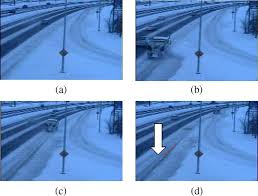
Video-based Automatic Incident Detection (AID) systems are widely deployed in many cities for detecting traffic incidents to provide smoother, safer and congestion free traffic flow. However, the accuracy of an AID system operating in an outdoor environment suffers from high false alarm rates due to environmental factors. These factors include snow movement, static shadow and static glare on the roads. In this paper, a robust real-time algorithm is proposed to detect snow movement in video streams to improve the rate of detection. This is done by having the AID system reducing its sensitivity in the areas that have snow movements. The feasibility of the proposed algorithm has been evaluated using traffic videos captured from several cameras at the City of Calgary.
Jun Cai, Mohamed Shehata, Wael Badawy, “A Robust Video-Based Algorithm for Detecting Snow Movement in Traffic Scenes”, The Journal of VLSI Signal Processing Systems for Signal, Image, and Video Technology, Special Issue on Signal Processing Systems, Volume 56, Numbers 2-3 / September, 2009, pp. 307-326.
Link to the list of other Peer Journal Publications

WHAT IS NTSC AND PAL STANDARD?
Although VHS video format is the same throughout the World, the video standard or electronic signal that is recorded on the cassette varies from country to country. The two most common video standards used are NTSC and PAL.
NTSC is the video system or standard used in North America and most of South America. In NTSC, 30 frames are transmitted each second. Each frame is made up of 525 individual scan lines.
PAL is the predominant video system or standard mostly used overseas. In PAL, 25 frames are transmitted each second. Each frame is made up of 625 individual scan lines.
There are other format as follows:
NTSC: National Television System Committee. Developed in the USA, also used by other countries. Utilizing the USA power net 60Hz as refreshing frequency
PAL: Phase Alternation Line. Developed in Germany, also used by other countries. Utilizing the European power net 50Hz as refreshing frequency.
SECAM: Sequential Couleur Avec Memoire. Developed in France also used by other countries. Utilizing the European power net 50Hz as refreshing frequency.
MESECAM: Mediterranean SECAM, a SECAM sub-standard developed for use in the Middle East and still used by a few countries. TV reception and playback may be viewed with both PAL and SECAM TV sets.
PAL-60: A substandard of PAL used by some countries, utilizing 60Hz instead of 50Hz refreshing frequency.
NTSC 4.43: An NTSC substandard. Most modern playback machines are dual mode and will switch automatically between versions 3.XX and 4.XX. Older machines may require manual switching or an additional external converter.
Here is a list of the countries and there popular formats:
|
Towards an H.264/AVC HW/SW Integrated Solution: An Efficient VBSME Architecture
Abstract:
This paper presents an efficient real-time variable block size motion estimation architecture. The proposed architecture provides motion vectors for each 16 times 16 block and its 40 sub-blocks. The proposed architecture is a single-instruction multiple-data architecture integrated with embedded SRAMs on one chip. The architecture has been prototyped using Xilinx Virtex-4 XC4VSX35-10 field-programmable gate array. It processes 30-CIF fps using 71-MHz clock frequency. Its maximum clock frequencyuency is 187.7 MHz and the maximum throughput is 20 4CIF fps. The prototyped architecture has 175 k gates and 18 kbits embedded SRAM.
Published in:
Circuits and Systems II: Express Briefs, IEEE Transactions on (Volume:55 , Issue: 9 )
- Page(s):
- 912 – 916
- ISSN :
- 1549-7747
- INSPEC Accession Number:
- 10185530
- DOI:
- 10.1109/TCSII.2008.923398
- Date of Publication :
- 23 May 2008
- Date of Current Version :
- 29 August 2008
- Issue Date :
- Sept. 2008
- Sponsored by :
- IEEE Circuits and Systems Society
- Publisher:
- IEEE
Mohammed Sayed, Wael Badawy, and Graham Jullien, “Towards an H.264/AVC HW/SW Integrated Solution: An Efficient VBSME Architecture”, IEEE Transactions on Circuits and Systems II, Volume: 55, Issue: 9, pp. 912-916, Sept. 2008.
Link to the list of other Peer Journal Publications
An Architecture for Programmable Multi-core IP Accelerated Platform with an Advanced Application of H.264 Codec Implementation
Abstract
A new integrated programmable platform architecture is presented, with the support of multiple accelerators and extensible processing cores. An advanced application for this architecture is to facilitate the implementation of H.264 baseline profile video codec. The platform architecture employs the novel concept of virtual socket and optimized memory access to increase the efficiency for video encoding. The proposed architecture is mapped on an integrated FPGA device, Annapolis WildCard-II™ or WildCard-4™, for verification. According to the evaluation under different configurations, the results show that the overall performance of the architecture, with the integrated accelerators, can sufficiently meet the real-time encoding requirement for H.264 BP at basic levels, and achieve about 2–5.5 and 1–3 dB improvement, in terms of PSNR, as compared with MPEG-2 MP and MPEG-4 SP, respectively. The architecture is highly extensible, and thus can be utilized to benefit the development of multi-standard video codec beyond the description in this paper.
Yifeng Qiu, Wael Badawy and Robert Turney, “An Architecture for Programmable Multi-core IP Accelerated Platform with an Advanced Application of H.264 Codec Implementation” Journal of Signal Processing Systems, Volume 57, Number 2 / November, 2009, 123-137.
Link to the list of other Peer Journal Publications