

The Operational Floating Current Conveyor and Its Application
A five-port general-purpose analog building block, termed as an Operational Floating Current Conveyor (OFCC), is described. The OFCC combines the features of current feedback operational amplifier, second-generation current conveyor and operational floating conveyor. An implementation scheme of the OFCC is described and its terminal operational characteristics are used to yield a working device. The OFCC is then used as a single block to realize the current conveyors (CCII+ and CCII-) as well as the four basic amplifiers (i.e., voltage, current, transconductance, and transresistance amplifiers). The applications of the OFCC are presented and discussed. In the field of the analog filter synthesis, we proposed a new active universal second order filter using OFCC. It has three inputs and one output employing two OFCC, two capacitors and three resistors and can realize lowpass, bandpass, highpass, notch, and all pass filters from the same configuration. The proposed universal filters offer the following advantageous features: using active elements for the same type (OFCC). No requirement for component matching or cancellation constraints, which makes the filter easier to design, orthogonal adjustment of ω0 and Q and the circuits have low sensitivity. The simulation and experimental results are obtained and discussed.
Read More: https://www.worldscientific.com/doi/abs/10.1142/S0218126606003118
Link to the list of other Peer Journal Publications
Yehya Ghallab, Wael Badawy, M. Abo El-Ella, and M. Elsaid, “The Operational Floating Current Conveyor and Its Application“, Journal of Circuits, Systems and Computers, Volume 15, No. 3, June 2006, pp. 351–372.
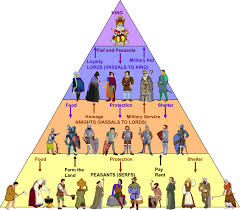
What is Feudalism?
A series of contractual relationships between the upper classes, designed to maintain control over land.
Feudalism flourished between the tenth and thirteenth centuries in western Europe. At its core, it was an agreement between a lord and a vassal. A person became a vassal by pledging political allegiance and providing military, political, and financial service to a lord. A lord possessed complete sovereignty over land, or acted in the service of another sovereign, usually a king. If a lord acted in the service of a king, the lord was considered a vassal of the king.
As part of the feudal agreement, the lord promised to protect the vassal and provided the vassal with a plot of land. This land could be passed on to the vassal’s heirs, giving the vassal tenure over the land. The vassal was also vested with the power to lease the land to others for profit, a practice known as subinfeudation. The entire agreement was called a fief, and a lord’s collection of fiefs was called a fiefdom.
The feudal bond was thus a combination of two key elements: fealty, or an oath of allegiance and pledge of service to the lord, and homage, or an Acknowledgment by the lord of the vassal’s tenure. The arrangement was not forced on the vassal; it was profitable for the vassal and made on mutual consent, and it fostered the allegiance necessary for royal control of distant lands.
The bond between a lord and a vassal was made in a ceremony that served to solemnize the fief. The vassal knelt before the lord and placed his hands between those of the lord as a sign of subordination. Immediately afterward, the lord raised the vassal to his feet and kissed him on the mouth to symbolize their social equality. The vassal then recited a predetermined oath of fealty, and the lord conveyed a plot of land to the vassal.
In the seventeenth century, more than three centuries after the death of this particular social practice, English scholars began to use the term feudalism to describe it. The word was derived by English scholars from foedum, the Latin form of fief. The meaning of feudalism has expanded since the seventeenth century, and it now commonly describes servitude and hierarchical oppression. However, feudalism is best understood as an initial stage in a social progression leading to private ownership of land and the creation of different estates, or interests in land.
Before feudalism, the European population consisted only of wealthy nobility and poor peasants. Little incentive existed for personal loyalty to sovereign rulers. Land was owned outright by nobility, and those who held land for lords held it purely at the lords’ will. Nevertheless, the feudal framework was preceded by similar systems, so its exact origin is disputed by scholars. Ancient Romans, and Germanic tribes in the eighth century, gave land to warriors, but unlike land grants under feudalism, these were not hereditary.
In the early ninth century, control of Europe was largely under the rule of one man, Emperor Charlemagne (771–814). After Charlemagne’s death, his descendants warred over land ownership, and Europe fell apart into thousands of seigniories, or kingdoms run by a sovereign lord. Men in the military service of lords began to press for support in the late ninth century, especially in France. Lords acquiesced, realizing the importance of a faithful military.
Military men, or knights, began to receive land, along with peasants for farmwork. Eventually, knights demanded that their estates be hereditary. Other persons in the professional service of royalty also began to demand and receive hereditary fiefs, and thus began the reign of feudalism.
In 1066, William the Conqueror invaded England from France and spread the feudal framework across the land. The feudal relationship between lord and vassal became the linchpin of English society. To become a vassal was no disgrace. Vassals held an overall status superior to that of peasants and were considered equal to lords in social status. They took leadership positions in their locality and also served as advisers for lords in feudal courts.
The price of a vassal’s power was allegiance to the lord, or fealty. Fealty carried with it an obligation of service, the most common form being knight service. A vassal under knight service was obliged to defend the fief from invasion and fight for a specified number of days in an offensive war. In wartime, knight service also called for guard duty at the lord’s castle for a specified period of time. In lieu of military service, some vassals were given socage, or tenure in exchange for the performance of a variety of duties. These duties were usually agricultural, but they could take on other forms, such as personal attendance to the lord. Other vassals were given scutage, in which the vassal agreed to pay money in lieu of military service. Priests received still other forms of tenure in exchange for their religious services.
A lord also enjoyed incidental benefits and rights in connection with a fief. For example, when a vassal died, the lord was entitled to a large sum of money from the vassal’s heirs. If the heir was a minor, the lord could sell or give away custody of the land and enjoy its profits until the heir came of age. A lord also had the right to reject the marriage of an heiress to a fief if he did not want the husband as his vassal. This kind of family involvement by the lord made the feudal relationship intimate and complex.
The relationship between a lord and a vassal depended on mutual respect. If the vassal refused to perform services or somehow impaired the lord’s interests, the lord could file suit against the vassal in feudal court to deprive him of his fief. At the same time, the lord was expected to treat the vassal with dignity, and to refrain from making unjust demands on the vassal. If the lord abused the vassal, the vassal could break faith with the lord and offer his services to another lord, preferably one who could protect the vassal against the wrath of the defied lord.
Predictably, the relationship between lord and vassal became a struggle for a reduction in the services required by the fief. Lords, as vassals of the king, joined their own vassals in revolt against the high cost of the feudal arrangement. In England, this struggle culminated in the Magna Charta, a constitutional document sealed by King John (1199–1216) in 1215 that signaled the beginning of the end for feudalism. The Magna Charta, forced on King John by his lords, contained 38 chapters outlining demands for liberty from the Crown, including limitations on the rights of the Crown over land.
Other circumstances also contributed to the decline of feudalism. As time passed, the power of organized religion increased, and religious leaders pressed for freedom from their service to lords and kings. At the same time, the development of an economic wealth apart from land led to the rise of a bourgeoisie, or middle class. The middle class established independent cities in Europe, which funded their military with taxes, not land-based feudal bonds. Royal sovereigns and cities began to establish parliamentary governments that made laws to replace the various rules attached to the feudal bond, and feudal courts lost jurisdiction to royal or municipal courts. By the fourteenth century, the peculiar arrangement known as feudalism was obsolete.
Feudalism is often confused with manorialism, but the two should be kept separate. Manorialism was another system of land use practiced in medieval Europe. Under it, peasants worked and lived on a lord’s land, called a manor. The peasants could not inherit the land, and the lord owed them nothing beyond protection and maintenance.
Feudalism should also be distinguished from the general brutality and oppression of medieval Europe. The popular understanding of feudalism often equates the bloody conquests of the medieval period (500–1500) with feudalism because feudalism was a predominant social framework for much of the period. However, feudalism was a relatively civil arrangement in an especially vicious time and place in history. The relationship of a vassal to a lord was servile, but it was also based on mutual respect, and feudalism stands as the first systematic, voluntary sale of inheritable land.
The remains of feudalism can be found in contemporary law regarding land. For example, a rental agreement is made between a landlord and a tenant, whose business relationship echoes that of a lord and a vassal. State property taxes on landowners resemble the services required of a vassal, and like the old feudal lords, state governments may take possession of land when a landowner dies with no will or heirs.
Further readings
Amt, Emilie, ed. 2000. Medieval England 1000–1500: A Reader. Orchard Park, N.Y.: Broadview Press.
Boureau, Alain. Lydia G. Cochrane, trans. 1998. The Lord’s First Night: The Myth of the Droit de Cuissage. Chicago: Univ. of Chicago Press.
Chen, Jim, and Edward S. Adams. 1997. “Feudalism Unmodified: Discourses on Farms and Firms.” Drake Law Review 45 (March): 361–433.
Dunbabin, Jean. 2000. France in the Making: 843–1180. Oxford: Oxford Univ. Press.
Ganshof, F.L. 1996. Feudalism. Toronto, Buffalo: Univ. of Toronto Press in Association with the Medieval Academy of America.
Hoyt, Robert S., and Stanley Chodorow. 1976. Europe in the Middle Ages. 3d ed. New York: Harcourt Brace, Jovanovich.
Lazarus, Richard J. 1992. “Debunking Environmental Feudalism: Promoting the Individual through the Collective Pursuit of Environmental Quality.” Iowa Law Review 77.

The power of one cent
What is the power of one cent?
To answer this question, imagine that one cent doubles every day. As shown in the table, one cent after 9 days can buy you a coffee at $2.56. One cent, after 20 days, can buy a car at $5,242.88. One cent after 30 days can buy your dream that is worth $5 Million dollars. AND, you keep it to the following day, you will become a double-digit millionaires. One cent will be a $1,374,389,534.72 on day 38 and will be $5,497,558,138.88 on day 40.
Then what?
The model above presents the strength of a network. I focus my effort to recruit my team and double double every day, or a week or a month. I can reach a powerful result and I have the passion and dedication to do it for 30 days.
The model is also applicable to sales, if I can double my sales every day, I can reach amazing business size after 30 cycles.
The cycle can be one week, one month, or even one year.
Just keep it doubling and do not rush and have the passion to be a billionaire starting with one cent.
John D. Rockefeller who is the world’s richest man and the first American worth more than a billion dollars, controlling 90% of all oil in the United States at his peak. said “I would rather earn 1% off a 100 people’s efforts than 100% of my own efforts.”


Five reasons why laws exist
Laws exist for five basic reasons, and all of them can be abused.
- The Harm Principle
Laws created under the Harm Principle are written to protect people from being harmed by others. Laws against violent crime and property crime fall into this category. Without basic Harm Principle laws, a society ultimately degenerates into despotism–the rule of the strong and violent over the weak and nonviolent. Harm Principle laws are essential, and every government on Earth has them.
- The Parental Principle
In addition to laws intended to discourage people from harming each other, some laws are written to prohibit self-harm. Parental Principle laws include compulsory attendance laws for children, laws against neglect of children and vulnerable adults, and laws banning the possession of certain drugs. Some Parental Principle laws are essential to protect children and vulnerable adults, but even in those cases they can be oppressive if they are not narrowly written and sensibly enforced.
- The Morality Principle
Some laws are based not strictly on harm or self-harm concerns, but also on promoting the personal morality of the law’s authors. These laws are usually, but not always, grounded in religious belief. Historically, most of these laws have something to do with sex–but some European laws against Holocaust denial and other forms of hate speech also appear to be motivated primarily by the Morality
- The Donation Principle
All governments have laws granting goods or services of some kind to its citizens. When these laws are used to control behavior, however, they can give some people, groups, or organizations unfair advantages over others. Laws promoting specific religious beliefs, for example, are gifts that governments extend to religious groups in hopes of gaining their support. Laws punishing certain corporate practices are sometimes used to reward corporations that are in the government’s good graces, and/or to punish corporations that are not. Some conservatives argue that many social service initiatives are Donation Principle laws intended to buy the support of low-income voters, who tend to vote Democratic.
- The Statist Principle
The most dangerous laws are those intended to protect the government from harm, or to increase its power for its own sake. Some Statist Principle laws are necessary–laws against treason and espionage, for example, are essential to the stability of government. But Statist Principle laws can also be dangerous–laws restricting criticism of the government, such as flag burning laws that prohibit the desecration of symbols that remind people of the government, can easily lead to a politically oppressive society full of imprisoned dissidents and frightened citizens who are afraid to speak out.

A Simplified 8×8 Transformation And Quantization Real-Time Ip-Block For Mpeg-4 H.264/Avc Applications: A New Design Flow Approach
Abstract
Current multimedia design processes suffer from the excessively large time spent on testing new IP-blocks with references based on large video encoders specifications (usually several thousands lines of code). The appropriate testing of a single IP-block may require the conversion of the overall encoder from software to hardware, which is difficult to complete in the short time required by the competition-driven reduced time-to-market demanded for the adoption of a new video coding standard. This paper presents a new design flow to accelerate the conformance testing of an IP-block using the H.264/AVC software reference model. An example block of the simplified 8 × 8 transformation and quantization, which is adopted in FRExt, is provided as a case study demonstrating the effectiveness of the approach.
Ihab Amer, Wael Badawy, Graham Jullien, Marco Mattavelli, And Robert Turney, “A Simplified 8×8 Transformation And Quantization Real-Time Ip-Block For Mpeg-4 H.264/Avc Applications: A New Design Flow Approach,” Journal of Circuits, Systems, and Computers Vol. 16, No. 6 (2007) 1011–1026
Link to the list of other Peer Journal Publications

Be a Red Apple and surround yourself with Red Apples and don’t mind the Green Apples
Like all aspects of life, and in business, we have different customers who can be negative, positive or neutral. We have different employee who can be negative, positive or neutral. We have different co-works who can be negative, positive or neutral. No matters what is the example, we will always find red apples, green apples and brown apples.
The Red apples are the good ones, the delicious one, the performers, the positive, the high energy etc.
The Green apples are the sour ones, the ones who do not want to move but they do not decide, the undecided, I call them waiting for the train to have a ride or a hit, etc.
The Brown apples are the bad ones, the negative, the rejection, the non-performers, the road blocker, the negatives, Etc. These are the bad influences, who can harm you.
To be successful, you must be a Red Apple, surrounded by at least 90% Red Apples and do not mind up to 10% Green Apples. But, avoid Brown Apples and have 0% Brown Apples in your life. Your goal is convert Green Apples to Red Apples. If you stuck with a Brown Apple, you will be Brown.
It is Red, Red, Red, Apple; and only Red Apple.
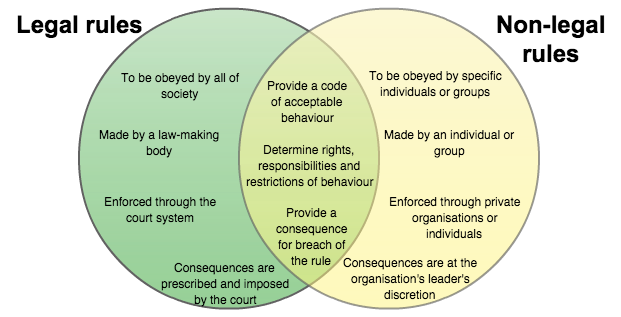
Legal Rules v. Non-legal Rules
Rules are principles that guide our behaviour. They can derive their authority from the law (made by parliament or the courts), or by an organisation or cultural expectation. Legal rules apply to everybody and the State provides a mechanism to enforce them.
Non-legal rules, when made by an organisation, only apply to people within that organisation. A society may enforce cultural norms through its media and individual people’s behaviour.
For example, a golf club may require its members to wear a certain colour of pants, and prevent its members from entering the club if they are not wearing the right coloured pants. The popular, fashion-forward girls in an American high school may laugh and turn their back on a girl wearing white pants after Labor Day, discouraging her from wearing them in future (deterrence). However, there is no legal rule about the colour of your pants, so nobody can sue you or report you to the police for that.
Whilst not strictly relevant right now, it is useful to keep in mind that there are different types of legal rules. Legal rules can be characterised in the following ways:
- their jurisdiction (state, federal or international application)
- the area of law (very broadly speaking, civil law or criminal law)
- their level of detail (laws or regulations)
- who they were made by (parliament/legislation, court/common law/case law/judge made law, subordinate/delegated authorities, constitutional powers).
The image above illustrates the similarities and differences between legal and non-legal rules.
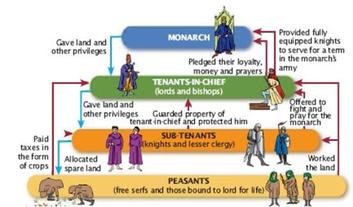
Law under the Feudal System.
By Cuming Walters.
TO the historian proper feudalism presents a wide subject with diverse points of interest, but its legal aspect is comparatively a small matter, and it can be considered without detailed reference to the whole vast scheme which existed from early German and Gothic times, and overspread the greater part of Europe. It is a common error to suppose that it was introduced into England by the Normans. William the Conqueror only superimposed a French form of feudalism upon that which already existed; and all historians agree that the measures he adopted, the restrictions he made, and the original conditions he established, were evidence of his farseeing genius, and a masterpiece of statecraft. His was a feudalism which, while giving the lords great personal power and influence, retained them still as the servants of the king, and totally prevented them from using their strength against the throne. In this respect the feudal system in England never resembled that of Germany and France, or even that which the Norman barons established in Scotland. The Conqueror had no intention of allowing the owners of territory to supersede his own authority, and to be beyond the sovereign’s control. While, therefore, he allowed them all liberty in dealing with their dependents, he made it impossible for them to defy his own authority, first by distributing their possessions so that they could not have a great army of followers at command, and, secondly, by insisting upon a formal declaration of allegiance from both the barons and their vassals. The former, therefore, were not beyond the law, and the latter had nominally, if not actually, some right of appeal to the monarch. These points it is necessary to bear in mind for a full understanding of legal procedure during the long period feudalism prevailed.
The feudal lord’s claims upon his vassals were numerous. First came his claim to their military service. He could demand from them service as assessors in his courts of various fines and payments and confiscations of land. He could dispose of females in marriage; not infrequently he consigned them to a debased existence. When the tenant was invested with possession of his feud or fief, he paid homage to his lord, that is, he proclaimed himself the “man” to help and to serve his master. Kneeling humbly before the baron, he took oath of fealty, and practically enslaved himself. It was here that King William showed his wisdom by ordaining that the oath of allegiance should be not only to the feudal superior, but to the monarch as the head of all, and thus he secured the ultimate service of all vassals to the crown, and deprived the barons of autocratic power.
The Saxon feudalism had been of the most tyrannical character, the owners of slaves making their own laws, and carrying them out with the utmost barbarism. Records exist which prove that for slight offences mistresses were accustomed to order their servants to be scourged to death, or subjected to fearful tortures. For breaking a dish, or spilling wine from a cup, for example, a servant might have his ears cut off, his nose slit, or suffer the loss of his hand, according to the caprice or fancy of his lord or lady. While murderers and robbers could find sanctuary in the Church, servants had no such refuge. They were torn away from the altar to which they clung in their terror, and none could or would intervene to protect them. According to the decree of King Ethelred, public punishments were to be mild, and death sentences were seldom to be passed; but the sovereign’s wishes had no effect upon the treatment of bondmen. High-born women were as cruel as their husbands, and King Ethelred’s own mother is said to have beaten him so severely when he was a child that he regarded whipping instruments with horror to the end of his life. Flagellation was not recognised as a legal punishment by the Saxons, though a husband might beat his wife and incur no penalty, while the whipping of slaves was accounted no more than the whipping of animals, and perhaps less. For all other classes money-fines were almost the only authorised penalty, a fixed price being set upon persons of different degrees. But the slave had no real value, and hence could be mutilated or killed at the pleasure of his lord.
The ideal of feudalism, never realised in England, was that the king and his tenants-in-chief should hold law-courts, which the tenant or the sub-tenants should be bound to attend to have their cases tried according to statute rules. But the system was only imperfectly carried out, and the fact that the tenant-in-chief, or feudal lord, had the right to levy taxes (called “tallage” or “tailles”) on his vassels, speedily led to all sorts of tyranny and abuse. Still, the feudal courts could not engross the legislation for the excellent reason that the quick-witted Conqueror had preserved the Witanagenot and the courts of the shire and the hundred to check the barons. The latter made a big effort to introduce the Continental system of feudalism, by which each of them would have been supreme in his domain; but the plans were defeated as we have seen. William’s successors were men of a different stamp, and the system proved unworkable in the hands of weaker men. “The prince,” says Hume, “finding that greater opposition was often made to him when he enforced the laws than when he violated them, was apt to render his own will and pleasure the sole rule of government, and on every emergency to consider the power of the persons whom he might offend rather than the rights of those whom he might injure.” The mischievous course pleased none, and the royal prerogative was at last systematically assailed by the barons in the time of John, and the Magna Charta wrestled from him. The concessions then made were of benefit to the barons rather than to the landless and dependent classes, and it remained for the third Edward to diminish their power and increase the liberties of the populace.
Law in England during all this period was chiefly a system of oppression, proceeding stage by stage from the highest to the lowest. The revenues of the crown were obtained by extravagant rents, forfeits, taxes, reliefs, fines, aids, and other devices which show the amazing ingenuity of the extortioners. The result was that most tyrannical exactions were made in turn by the feudal lords, and the dependents groaned for six centuries under these lawless yet legalised oppressions. Personal property was at the mercy of the lords, who adopted the most cruel means to enforce their “rights.” They, in turn, could be the victim of extortions, as was proved in the case of Roger of Dudley, who was summoned to receive the honour of knighthood in 1233. He found the honour so expensive that he declined to appear, whereupon a writ was issued—“Because Roger de Someri, at the feast of Pentecost last last, has not appeared before the King to be girded with the military girdle, the Sheriff of Worcestershire is hereby commanded to seize on the house of Dudley and all other lands of the said Roger within his jurisdiction, for the King’s use; and to keep them with all the cattle found upon them, so that nothing may be moved off without the King’s permission.” The same Roger had a twelve years’ dispute with William de Birmingham touching the service due for the manor of Birmingham, for which the latter was required to perform the service of eight knights’ fees, a half and a fourth part, and also to do suit to the court at Dudley once every three weeks. In such wise did these cheftains rule. Another curious piece of law relating to the Dudley lands is told by Leland:—“The lorde Powis, grauntfather that is now, being in a controversy for asawte made upon hym goying to London by the lord Dudeley, Dudeley castelle condesended by entreaty, that his son and heir should mary the olde lorde of Dudleis’ daughter.” A very amiable method of atoning for personal violence.
The feudal lord had absolute power over his own family, as well as over his dependents, the laws of household government being entirely of his own devising and prompted by his passion, his ignorance, and his wickedness. Robert de Belesme, Earl of Shropshire and of Arundel and Shrewsbury, one of the most powerful and defiant barons of Norman times, tore out the eyes of his own children when they had, in sport, hidden their faces beneath his cloak. He cast his wife in a dungeon, heavily fettered; but every night he sent his servants to drag her to his bed, and in the morning sent her back to her prison. This torture he inflicted upon her to gain money from her family. He disdained to allow his captives in war to be ransomed, but impaled them, men and women, upon stakes. His friends were terrified to approach him, for by way of pleasantry he would engage them in merry chat and suddenly plunge his sword into their sides with a loud laugh. No law could touch this man, and no avenger arose to overcome him. The Warden of the Welsh and English Marches made also his own laws, which were conceived in a spirit of the utmost cruelty. Border foragers, for example, were cast into a dungeon, and subjected to the punishment of having their right hands chopped off with the axe. This prescribed penalty was often aggravated by additional torture or death.
Feudalism was deep-rooted, so deep-rooted that not the enactments of all the Normans and Plantagenets could do more than check its growth and gradually ameliorate its severities. But while some of the old customs were abolished, the bulk of the laws remained based upon the Anglo-Saxon customs, so that as one writer has tersely explained, “the Land Laws and Game Laws are derived from the Normans, the Common Law from the Anglo-Saxons, and almost all our Statute Laws breathe the spirit of pre-Norman England.” To this Macaulay refers with ill-disguised scorn in his History: “Our laws and customs have never been lost in general irreparable ruin. With us the proceedings of the Middle Ages are still valid precedents, and are still cited on the gravest occasions by the most eminent statesmen…. Thus in our country the dearest interests of parties have been staked on the results of the researches of antiquaries.” The historian, however, does admit that there is compensation for the anomalies which result from this polity. “Other societies possess written constitutions more symmetrical. But no other society has yet succeeded in uniting revolution with prescription, progress with stability, the energy of youth with the majesty of immemorial antiquity.” That the spirit of olden feudalism should sometimes be found surviving in modern laws is inevitable. Villenage is extinguished, and yet in the very character of certain classes, as well as in the operation of certain laws affecting lands and personal privileges, we see a direct connection between the submission of the bondman in the past to his hereditary master and the readiness of the poor in the present to yield to one in higher station. What struck the philosophic Emerson most, on his visit to England, was that Englishmen should maintain their old customs, repeat the ceremonies of the eleventh century, and consider in so many things that “antiquity of usage is sanction enough.” “The Middle Ages,” he said, “still lurk in the streets of London.”
The stocks and the whipping-post, which stood in front of every castle, were the commonest instruments in use for the punishment of the ceorl and villein who displeased their masters. For the ceorl, who could not quit the land on which he was born, or free himself from slavery, life was particularly hard. He could not absolve himself by money payments, like the rest of his fellow-men, if once he gave offence; while the majority could rob and murder and escape with a fine, the ceorl’s slightest defect, real or imagined, was punished with merciless rigour. Tithings and the process of compurgation came to the assistance of other criminals, but the ceorl could appeal to none, and expect neither pity nor aid. Such facts give point to Emerson’s dictum that “Castles are proud things, but ’tis safest to be outside them.” The villein was in a much happier state than the ceorl. He was free against everybody except his lord, and the criminal code accorded him the same privileges as a free man. The lord was even liable to punishment for killing or mutilating his villein, and the Mirror of Justice in the thirteenth century laid down the fact that “the villein is no serf in any sense of the word; he is a free man; his land is a free tenure.” But all this is largely comparative, and our estimate of the advantages enjoyed by the villein must depend upon whether we view it by the standards of the time, or by modern standards. At all events, while the ceorl tasted all the bitterness of his serfdom, the adjudged felon in other stations was able to obtain much leniency. The common form of oath or abjuration in King Edward’s time was this: “This heare, thou Sir Coroner, that I am a robber and a murderer, and a fellow of our Lord the King of England; and because I have done many such evils in his lande I do abjure the lande of our Lord Edward, and I shall haste me towards the port of ——, which thou hast given me, and that I shall not goe out of the highway, and if I doe, I will that I be taken as a robber and a felon. And that at such a place I will diligentlie seeke for passage, and I will tarrie there but one ebbe and flood, if I can have passage; and unlesse I can have it in such a place I will goe every day into the sea up to my knees, assaying to pass over; and unlesse I can do this within fortie days I will put myselfe again into the Church as a robber and a felon, so God me helpe and his holy judgment.” But King Richard showed no disposition to put so much trust in the honour of these gentry, and when setting out for Palestine, he made a law against peculating sailors, which was calculated to dismay them: “Whosoever is convicted of theft shall have his head shaved, melted pitch poured upon it, and the feathers from a pillow shaken over it, that he may be known; and shall be put on shore on the first land which the ship touches.” This punishment reminds us of a modern American institution.
The law of “Englishry” deserves a passing note. It dates back to the time of Canute, and was continued by the Normans. When Canute sent away the greater portion of his Danish troops, “the Witan pledged themselves that the rest should be safe in life and limb, and that any Englishman who killed any of them should suffer punishment. If the murderer could not be discovered, the township or hundred was fined.” The proud and tyrannical Normans used this law to their own advantage. A mere Englishman being a vassal, and of no importance, could be killed with impunity, but it was ordained that when a man was found killed, and evidence was not brought to prove that he was English, he should be held to be a Frenchman, so that a penalty could be imposed upon the township. This law of “Englishry” is often illustrated in old chronicles. Men were found murdered by the roadside, on heaths, and in woods; the chronicles state that “no Englishry was proved,” and the towns were accordingly amerced. The “Frankpledge” was not so feudal in character, though it was based upon the principle that “every landless man shall have a lord who shall answer for his appearance in the courts of law.” The custom prevailed before the Conquest, ten men forming a “tithing,” the members of which were answerable each for others. The present Court Leet is a survival of the system, though in a very modified form.
The feudalism which the Norman barons imposed upon Scotland, and which was unchecked by King William, so that it reproduced all the evils of the ferocious Continental system, was marked by terrible excesses. No institution was more shameful and abhorrent, or so vividly reveals the baseness to which unrestricted feudalism sank, than the horrible depravity of maiden-rights, or droits de seigneur. Beaumont and Fletcher founded upon the historic incidents their drama of “The Custom of the Country,” and though a few mild attempts have been made to throw doubt upon the facts, there is no question that these domestic tyrannies spread rapidly from Scotland to France and Germany, and took numerous odious forms. Isaac Disraeli, in his “Curiosities,” devotes a chapter to the subject, which can scarcely be dealt with in detail in a work appealing to the general reader. The shameful institution was abolished by Malcolm III., who, however, put the matter upon a business basis by ordering that it should be redeemed by a quit-rent. But the lord still considered himself privileged to manifest his authority over his vassals by thrusting his booted leg into the bed of a newly-married couple, or by sousing the bridegroom in a river. The wardships enjoyed by the feudal lords were equally absurd, one of their favourite methods of raising money being to arrange an unsuitable marriage, and on the refusal of the persons to carry out the contract, to claim the revenue of the wards’ estate as “forfeit.” The feudal lord could sell his vassals as he did his animals, and they were often bartered away with fields and houses. The value of a serf was roughly apprised as four times that of an ox, and he could also be used as “live money.”
Mr. Ruskin, in his third letter in “Fors Clavigera,” gives an account of the laws promulgated by King Richard, Cœur de Lion, whom he declared to be the truest representative of the British “Squire,” under all the significances of that name. The ideal lord was an admixture of the patriarch and the tyrant, and if we examine Richard’s legislation, and endeavour to recognise the objects he had in view, we see that with a considerable amount of selfishness he also possessed a real wish to add to the welfare of his people. He simplified and adjusted the weights and measures of the country to put an end to cheating, and he took severe measures “to prevent the extortions of the Jews.” If the people would be honest, he was quite willing to do the fighting for them; if they made good cloth, he was ready to see that they got good pay; and when they bought and sold, he was determined that each should give the other good measure. But with much power comes caprice, and the feudal lords too soon forgot the interests of their dependents in serving their own ends. The English barons never made the formal claim of the German barons to rob on the highways in their own territories, though, without asserting the right, they frequently performed the act. A case in point is that of William de Birmingham, who so late as the sixteenth century went out with a hundred men to molest and rob travellers on foot. The ordinary laws were unequal to calling them to account for these misdeeds; nothing but conquest by battle could have checked them. Besides, there were Lord Palatines whose rule in their own domains was equal to that of the sovereigns, and they could make or abrogate laws at will. These kings in petto appointed their own judges and courts, could reverse sentences, pardon at will for any crime, and indict at pleasure. Offences committed in the County Palatine were said to be “against the peace” of the lord, and not against the peace of the king, and it was with a rod of iron that these despots governed the territory allotted to them. Still there was a show of legality in this. It differed from the wanton caprice of Geoffrey of Coventry, who oppressed the inhabitants, was amenable to no law for so doing, but consented to remit the burdensome taxes if his wife would ride naked through the streets. As a specimen of the barbarous humour of these lords, the Godiva story is instructive.
At the end of King Stephen’s troublous reign, there were eleven hundred and fifteen castles in England, each of them a centre of power, at that particular time almost absolute. The wise provisions of the Conqueror had to some extent been overcome, and the feudal lords had become so unmanageable that Henry II. found himself compelled to stipulate for the destruction of a number of the strongholds. At the same time he prevented the erection of others except by royal licence, and so began to limit the oppression which had prevailed. We find, too, that in consequence of the frequent over-riding of the common law by men in authority, the monarch reserved to himself more and more of sovereign power, “by which,” says Sir Robert Filmer in his famous “Patriarcha”—answered by John Locke in the still more famous treatises on Civil Government—“he did supply the want or correct the rigour of the common law, because the positive law, being grounded upon that which happens for the most part, cannot forsee every particular which time and experience bring forth. Already sundry things do fall out,” he continues later, “both in war and peace, that require extraordinary help … so that rare matters do grow up meet to be referred to the absolute authority of the prince.” We find such a case in the time of Richard II., when, on a question of freehold, the appeal went direct to the king because “of maintenance, oppression, or other outrages the common law cannot have duly her course.”
How the lords could avoid and defy the common law is proved by two curious instances in the history of the Dudleys, the family previously referred to. Lord Edward Dudley, in 1592, had a dispute with the neighbouring Lyttelton family, and raising some 150 persons, he went one night and stole all the cattle on the latter’s estate. Lyttelton obtained judgment against Dudley, who was ordered to return the cattle, but he posted his servants at the gates, and bade them cut the bailiffs to pieces. Lyttelton then armed sixty men and took the cattle back by force; Dudley armed 700 men to fetch them back and kill them. For this offence the nobleman and eighty followers were indicted, but by one means and another the proceedings were made to last four years, and then an agreement was entered into by the parties. Lord Edward’s son, Ferdinando, was the hero of the next exploit. He purchased the property of an oppressed widow, named Martha Grovenor, for £1200, but only paid £100. She sued him in the Exchequer for the remainder, and obtained judgment for the balance. No notice was taken of this. The following year the widow obtained a second decree, and this again was ignored. His lordship was next called upon for costs, and this led him to make an effort to compromise the matter. He entered into an agreement to pay all arrears and costs, but, having done so much, refused to fulfil his obligations. An execution of ejectment was then levied against his lordship. This he avoided for nine years, and it was only twelve years after negotiations had begun that the widow was able to obtain her dues.
A very brief glance at Continental feudalism and its influence upon statute law may now be given. It enables us to mark some of the differences between the English and the foreign systems, the one with its restrictions and the other all-powerful. In the eleventh century, all France and the German Empire were one vast feudal possession. The powers of the lords have been classed by the historian Hallam as follows—First, the right of coining money; second, that of waging private war; third, exemption from all public tributes except the feudal aids; fourth, freedom from legislative control; and fifth, the exclusive exercise of original judicature in their dominions. It is easy to perceive how, with these initial powers conceded, the seigneurs were enabled to make themselves the veritable masters of the kingdom. In Germany the lawlessness of the barons became as proverbial as did their cruelty towards their slaves. The whole country was divided up into territories over which the feudal chiefs reigned as absolute and despotic kings. Nor is the spirit of feudalism in that country yet extinct, for, unlike France, it has not had its bloody revolt against “aristocrats.” No one can have travelled in Germany and seen the castle towering high on crag or rock, and the diminutive houses scattered about its base, without realising at a glance how the chieftains and their serfs lived in the old days. In Germany the feudal system was seen at its strongest and its worst, and law was paralysed while the men of lust and blood were supreme in their own dominions. Austria has a similar story to tell of barbarity towards serfs, and the abrogation of law by powerful chieftains. But it is remarkable that in Russia, where the feudal spirit still most strongly survives, and is marked by many excesses utterly repugnant to the feeling and customs of the times, the earliest attempts to establish a feudal system were quelled by the princes. In this land, where a mistress might, until recently, have her maid whipped to death for dropping a teacup, or for any other trivial offence, real or imagined, where again it was taken for granted that
“A Count carbonadoes
His ignorant serfs with the knout,”
feudalism, once instituted, deepened its hold with the progress of years. While there was no law for the lower classes, save that dictated by the caprice of their masters, there were special exemptions and priveleges for the noble and wealthy. The Russian lords pay no taxes, and they retain, in almost undiminished force, that power to abuse, insult, and destroy the peasantry which was possessed by the ancienne noblesse of France before the Revolution. Mr. Morley Roberts, in one of his Russian historical sketches, relates that not long ago a noble threw a Hebrew into a dungeon for an offence, and a week later asked his jäger what had become of him. “Oh,” said the fellow with a laugh, “he made so much noise that I shot him.”
The state of Bohemia from the ninth to the fourteenth century shows to what deplorable depths a race may sink under an unrestrained and licentious feudalism. The Bohemian nobles practically abolished the marriage laws, and in addition to oppressing their dependents, frequently sold them into slavery. When St. Adalbert endeavoured to effect a reformation, he found every impediment put in his way, and his wishes openly defied. He had a horror of bloodshed, and preached the hatefulness of murder. By way of response, a man, whose wife had been put in a nunnery to save her from his brutality, was dragged out and butchered in the streets. Adalbert had to wait long before he could influence these men who, secure in their castles, could indulge their rapacity without fear of punishment. Reforms, effected in the tenth century, however, were not permanent, and in the twelfth century the nobles had succeeded in converting the local assembly, with its power of appointing judges, to their own uses. Mr. Edmund Maurice, in his history of Bohemia, relates that the nobles began to secure the judgeships for themselves, and then sold or bequeathed the offices to heirs. They thus made the appointments a means of tyranny and a source of profit, and with the money acquired purchased the lands of freemen. Others, owing to the unpopularity of the local tribunals, strengthened the power of their own feudal courts, and again reduced their dependents to abject slavery.
“The coolness,” says Mr. Maurice, “with which many of the grants of land transferred workmen of various kinds as mere appendages of fields and fishponds, is in itself a proof of the degraded position to which the peasant class had been reduced; and the fact that military service seemed one of the few means of escaping from serfdom, led the peasants to favour those wars which in the end increased their misery.” Eventually King Wenceslas, famed in ballad, and still more famed in Bohemian history, came to the rescue, and ordained “that no baron or noble of the land shall have power in the city of Brünn, or shall do any violence in it, or shall detain anyone, without the license and proclamation of the judge of the city.”
The wide survey we have taken enables a fair estimate to be made of the state of the law in Europe when the castle was the court of justice, and the baron was the judge. England alone of all Europeon countries seems to have been able to place a check upon the more flagrant abuses, and in later times of reform to have succeeded, while abolishing what was essentially evil in the system, in retaining whatever of it was of worth. Whether there be still laws too deeply impressed with feudal ideas for modern acceptance is a question for legislators to consider.

On Symbols.
By George Neilson.
THE wayward fancies of mankind are well illustrated in the diversity of symbolic observances, some never losing their meaning, some absolutely unintelligible in their historic form, and some as much characterised by a befitting dignity, as others are by the want of it. All once were self-explanatory and possessed a measure of propriety proportioned to the state of the people amidst whom they originated. But tradition is long, centuries elapse, each modifying a ceremony, and when the procedure emerges within the knowledge of record, it has often so lost touch with its surroundings, that it is hopeless to speculate how it arose.
Symbols are drawn from and applied to every field of human activity. Of course in a general sense man expresses himself only so, and a regular alphabet is but a comparatively trifling advance on the language of signs. What we call civilization, is at bottom little more than a clear recognition of certain symbols of government. The Queen’s crown, the Judge’s ermine, the Mayor’s mace, what are they else? The sceptre is only a glorified stick, of which the policeman’s baton is a humbler shape. Each embodies the great thought that behind it stands a nation’s determination to be ruled by law.
In the history of law, symbol and the traces of symbol meet us at every turn. The middle ages teemed with them. Roman law had bequeathed not a few. Perhaps the most wondrous of them all is one that has long ceased to have any legal connection, although its mark is all-powerful over civilisation. How daring was the imagination which prompted the choice, for the heraldic badge of Christianity, of the dread emblem of capital punishment by crucifixion! In the pure domain of the law of the early and middle ages, a perfect wilderness of symbols presents itself to eyes which strive to explore the origins of institutions.
Law is ever beset by a tendency towards formalism, and in early times a severe insistence upon ceremony, no doubt, gave prominence and prescriptive sanction to symbolic acts. Law and custom after all only mean that the way things were done yesterday is the safest way of doing them to-day. The acceptance of a common form implies a very large public consent, which is equally necessary to its abrogation, once it is accepted. No small part of its value lies in its certainty, “certainty which,” Coke well says, “is the mother of quiet and repose.”
Hence the fixity and longevity of many emblematic methods of performing acts affecting status or property rights. The constitution or discharge of slavery, or the transfer of a slave from one master to another, had a variety of set forms. A freeman might deliver himself to serfage by putting a leathern thong upon his neck. When a church was the donee, the ceremony might take place at the altar, and the man present himself there with cords round his throat. “Thus he offered himself,” says an old record, “to the Almighty Lord.” A coin or two on the head was also a customary part of the process. In the manumission or liberation of the slave, these coins struck off the head served the purpose of declaring him free, as did the companion symbol of open doors, or the placing him at four cross roads, and bidding him go whither he would. Another common symbol of enfranchisement was the delivery of an arrow, thought to denote the right confined to freemen of bearing arms.
Even a short account of legal symbols would make a very large treatise. Single instances such as the ring, the staff, the glove, and the horn would each furnish material for an elaborate monograph. The theme would call for a discussion of the great war of investitures, and would touch very many points of ecclesiastical, civil, and criminal law and history. The scope of the present unambitious article is only directed to a few illustrations in relation to the transfer of land, the act of divesting the old proprietor and clothing the new with his rights. Although such symbols usually had a connexion with the subject conveyed, there are many types in which that connexion is not readily traceable. Why for example amongst the Saxons should a resignation of all interest in an estate have been made by a gesture with curved fingers? One can understand why a sod should be so often a token, but why does the glove play so large a part in Merovingian and Carolingian conveyancing? Was it, indeed, as German scholars speculate, because the donor metaphorically took it off and the donee put it on, making his the covered hand, the vestita manus, that would defend the land conveyed? How came an eleventh century magnate to attest his renunciation of justiciary rights to a monastery “by cutting off the top of the silk band by which his fur robes were fastened to his breast, and with that segment re-investing three monks therein?” In this case a portion of that silken band was carefully sewn up, as an adminicle of evidence, in the writ recording the transaction. How again came it that a claim of feudal service might be departed from by the delivery and placing of a wand (virgula) upon the altar? All these are much more personal symbols than real. They are mainly guarantees of the grantor’s good faith. They do not seem to be primarily emblems of possession. The contrast between these two classes will be best appreciated by considering types of the latter.
When a purchaser proceeded to set up fresh boundary marks, or to take a spade and dig, or when he received delivery of a sod with grass or shrubbery upon it, or lifted from the ground the charter granted by the seller with amongst other things a sod laid thereon, the act of seisin, the formal occupation is visibly completed. Of this class of symbol, the sod (cespes) is probably the best and most typical for a few words of illustration. We read of litigants laying judicial claim to land in the mall or public court by putting their spears into a sod, representative of the subject in dispute. We hear of the sods being cut in the shape of bricks, and of their being preserved as memorials, with the twigs growing in and incorporated with them. We hear of sods offered on the altar when the grant of land was being made to a church. We hear of transfer from one vassal to another being accomplished by the grantor delivering the sod to the over-lord, and the latter passing it on to the grantee.
Of all the symbols employed in connection with feoffments, however, the rod (festuca) had the widest vogue on the continent. Not that it was restricted to transactions in land; it was a more or less lineal descendant of the Roman stipulation, a contract visibly expressed by the parties breaking a straw between them. Under Charlemagne a renunciation by certain priests was made by them “holding straws in their hands and casting them from them before God and his angels.” Later this appears as a recognised method of renunciation, but with a rod substituted for the straw. In some cases the fact of renunciation is emphasised by the rod being not only thrown to the ground by the resigner, but trodden under foot when there. The rôle of the festuca was peculiarly important amongst the Frankish peoples.[3] Galbert of Bruges, a Flemish twelfth century historian, states that the counts of Flanders gave investitures to their vassals, after receiving their fealty and homage, by a wand (virgula) held in hand, and he has a dramatic passage describing how the people of Bruges, in token of their renunciation of their feudal bond to Hacket the castellan, “picking up bits of stick exfestucated their homage and fealty,” i.e. cast the rods from them, and so doing severed all connexion with their former chief.
In England and in Scotland, this rod symbol (fustis et baculus) also played a large part. Bracton referred it specially to land without houses. Tenure by the verge, a species of copyhold, had its name, we learn from Littleton, from un petite verge, delivered by the old tenant to the steward or bailiff of the manor, who re-delivered it to the new holder. Jordan Fantosme tells us that when Brien, messenger of Ranulf Glanvil, in 1174, announced in Westminster the capture of the Scottish King at Alnwick, Henry II. rewarded him for his good news by handing him a stick (bastuncel), which vested him in ten librates of land. In Scotland the feudal resignation by a vassal to his overlord for the re-investure of a fresh owner was effected by “staff and baton” (fustis et baculus), and references to those symbols occurred in every day conveyancing until far into the present century. Indeed this picturesque ritual was, strictly speaking, not abrogated, although made unnecessary, by the Act 8 and 9 Victoria ch. 35.
The commonest conveyancing symbol for land in England was the formal delivery of turf or twig of the ground conveyed, made by a representative of the grantor, to a representative of the grantee. The most familiar in Scotland was the handing over of “earth and stone.” This latter was the normal form of seisin, and its history goes far back, not only in Scotland, but on the continent as well. A curious Saxon legend attests this. Widukind narrates that some Saxons, having landed from their ships in Thuringia, one of them, wearing a golden torque and bracelets, met a Thuringian, who asked if he would sell his ornaments. The sly Saxon entered into an odd transaction; the Thuringian gave him in exchange for his gold, a lapful of soil. The Thuringians rejoiced exceedingly over the smart bargain their countryman had made, but changed their tune when soon afterwards the Saxons claimed the land as theirs, purchased with their own gold, and by force of arms made good the demand.
Our chronicles have a good many stories about symbols. In the Norman Brevis Relatio, a sketch of the origin of William the Conqueror, is told of his grandfather, Duke Richard the Good, that once when staying at a monastery, after prayer in the morning he laid a spindle on the altar. Upon being asked what it meant, he named the manor which he had by so homely a symbol bestowed for the good of his soul. When the infant William came into the world, it was said,—and afterwards noted as prophetic—that when they laid him down upon some straw, the little hands each clutched a handful. Acquisitive tendencies were foreshadowed! The Roman de Rou tells that in 1066, when William landed in England, he stumbled and fell, an omen which for the moment disconcerted his followers, but rising with a shout, he swore by the splendour of God that with his two hands he had taken possession of the land. Prompt to catch the occasion, one of his men ran forward to a cottage, tore a handful of thatch from the roof, and passed it to his chief, with the cry, “Receive this seisin,”—quasi-ceremonial words which with William’s pious, “God be with me,” the curious may compare with the formalities of English livery in deed, as described (sec. 59), in Coke upon Littleton.
The normal symbol of seisin for a house in England, was (before the Act 7 and 8 Victoria ch., 76, superseded these archaic ceremonies), was the ring or hasp of the door, known in Scotland for houses in burghs as “hasp and staple.” In the latter country also, there were a good many special types of symbol characteristically appropriate to seisin in special kinds of property. Thus for mills “clap and hopper,” for fishings “net and coble,” for teinds (Anglice tithes) a sheaf of corn, for the patronage or advowson of a church a psalm-book and keys, attained the figurative purpose requisite. There were many others less familiar amongst them, one, a hat, worthy of a few words all to itself. Our own generation may not regard this as a particularly dignified symbol, but there is a cloud of witnesses to shew its very various applicability. The priest’s cap or biretta was sometimes employed to instal him in a chaplainry or benefice. And apart from the place of the hat in the regulations of the tilting ring, it was occasionally used in Scotland as a symbol in connection with what were known as heirship goods. But it had in the twelfth century been accorded the very loftiest use to which secular symbolism could be turned. In 1175, King William the Lion, taken prisoner the year before, relinquished the independence of Scotland, and did homage to the English King at York, as a condition of his liberation. The contemporary records are silent regarding symbolic details, but in 1301 Edward I. stated in his letter to the Pope that “in token of his fealty, William the King of Scotland, had, on the altar of St. Peter’s, at York, offered his cap (chappelus), lance, and saddle, which until this day remain and are preserved in said church.” Any incredulity which a fair-minded Scot can entertain, regarding this allegation that the freedom of his country was once symbolically surrendered in King William’s cap, will be materially lessened, and Scottish patriotism so far consoled, by the recollection that under very similar circumstances the realm of England was in 1193 given away with the bonnet (pilleus) of the captive Richard I., who, thus (as Hoveden tells us), gave investiture of his kingdom to his arch-enemy, the Emperor Henry VI. This was, however, only formal: the Emperor at once re-invested King Richard in his realm with a double crown of gold, though subject to an annual tribute of £15,000—a business transaction painfully illustrative of the Christian chivalry of the Crusades.
The annals of Scotland boast one instance of a royal symbol much more regal than either of these two. About the beginning of the year 1124, King Alexander I., restoring by charter to the Bishopric of St. Andrews an extensive tract of land, completed the grant according to Andrew of Wyntoun (vii., 5), in a truly stately fashion. He—
Gert than to the awtare bryng
Hys cumly sted off Araby
Sadelyd and brydelyd costlykly
Coveryd with a fayre mantlete
Off precyous and fyne welvet
Wyth his armwris off Turky
That pryncys than oysid generaly
And chesyd mast for thare delyte
Wyth scheld and spere off sylvyr qwhyt.
It was a special occasion, for Bishop Robert’s appointment, which had led to the grant, was a Scottish victory over the pretensions of the See of York. There is an appeal to the imagination so strong in the scene, that, in spite of the interval of 300 years betwixt the event and this oldest record of it, one is slow to offer any criticism on the charger; more especially as the entire verity of the silver spear is corroborated by Walter Bower’s enshrining in his Scotichronicon the fact that in the fifteenth century it was doing duty as the shaft of the cross in the Cathedral. Yet the unexampled symbol, coupled with the analogy from York in 1175, compels the suggestion, that perhaps during these 300 years an original capellus have been mis-read as caballus, or mistaken for Scottish capul, and thus by the magic of mistranslation, a king’s cap may have been transmuted into an Arab steed.
Whilst of course a crown was the standard symbol of investiture for a kingdom, inferior rights of principality were often typified by other things, such as a sword, a spear, or a banner. And as feudal forms were observed in the bestowal, so were they sometimes in the taking away. England dispensed with several of her monarchs, but apparently in no case was a deposition attended by the feudal solemnities. In Scotland when, in 1296, King John Balliol was pulled out of the throne by the same hands as had placed him in it, Edward I. spared his vassal little of the indignity of the situation. Balliol, deprived of his royal ornaments, with the ermine stripped from his tabard, resigned his realm by the symbol of a white wand.
Than this Jhon tuk a quhyt wand
And gave wp in till Edwardis hand
Off this Kynryk all the rycht.
No Scottish historian has noticed the absolute legal propriety of this, and it is worth noticing. By contemporary law (Britton, ii., 22), une blaunche verge was the recognised symbol of disseisin by consent. The thirteenth century was very particular, even in small things, about its law. Disseisin, provided for by statute of 1429, in disputed successions to real property, and known to Scotland as the breaking of seisin, was symbolically affected—frangendo discum—by the curiously expressive act of breaking a dish or dishes, with fire underneath.

CAVLC Encoder Design for Real-Time Mobile Video Applications
Abstract
This brief presents a new context-based adaptive variable length coding (CAVLC) architecture. The prototype is designed for the H.264/AVC baseline profile entropy coder. The proposed design offers area savings by reducing the size of the statistic buffer. The arithmetic table elimination technique further reduces the area. The split VLC tables simplify the process of bit-stream generation and also help in reducing some area. The proposed architecture is implemented on Xilinx Virtex II field-programmable gate array (2v3000fg676-4). Simulation result shows that the architecture is capable of processing common/quarter-common intermediate format frame sequences in real-time at a core speed of 50 MHz with 6.85-K logic gates.
Published in:
Circuits and Systems II: Express Briefs, IEEE Transactions on (Volume:54 , Issue: 10 )
- Page(s):
- 873 – 877
- ISSN :
- 1549-7747
- INSPEC Accession Number:
- 9633945
- DOI:
- 10.1109/TCSII.2007.902215
- Date of Publication :
- Oct. 2007
- Date of Current Version :
- 15 October 2007
- Issue Date :
- Oct. 2007
- Sponsored by :
- IEEE Circuits and Systems Society
- Publisher:
- IEEE
C. A. Rahman and W. Badawy, “CAVLC Encoder Design for Real-time Mobile Video Applications”, The IEEE Trans. on Circuits and Systems II, Oct. 2007 Vol 54, Issue: 10, pp. 873-877.
Link to the list of other Peer Journal Publications